Solar isn’t an impulse buy. No one scrolls through their inbox, sees a promotion or sale for solar panels, and clicks “Add to Cart.” It’s a major investment and a long and high-consideration purchase with a complex sales cycle. Homeowners need reassurance and many touchpoints before they make a final decision.
Solar email marketing plays an important role in this process. However, it’s not the easiest endeavor. Many solar companies face issues with low open rates and poor engagement.
Our guide will walk you through building an effective email marketing strategy for your solar sales. You’ll learn how to educate and nurture homeowners, how to use email automation tools, and connect your efforts with solar design software solutions like SolarGenix that handle lead capture and solar proposal generation.
Key Takeaways
- Organic and segmented lists perform better than purchased lists.
- Open rates and engagement are directly linked to personalization, engaging subject lines, and mobile friendliness.
- Drip campaigns do the follow-up for you.
- Targeted messaging arises naturally from proper segmentation by location, bill amount, and buyer journey stage.
- Client testimonials help build trust and credibility.
- Re-engagement campaigns can recover cold leads via incentives or alternative, low-pressure offers.
Why is Email Marketing Essential for Solar Companies?
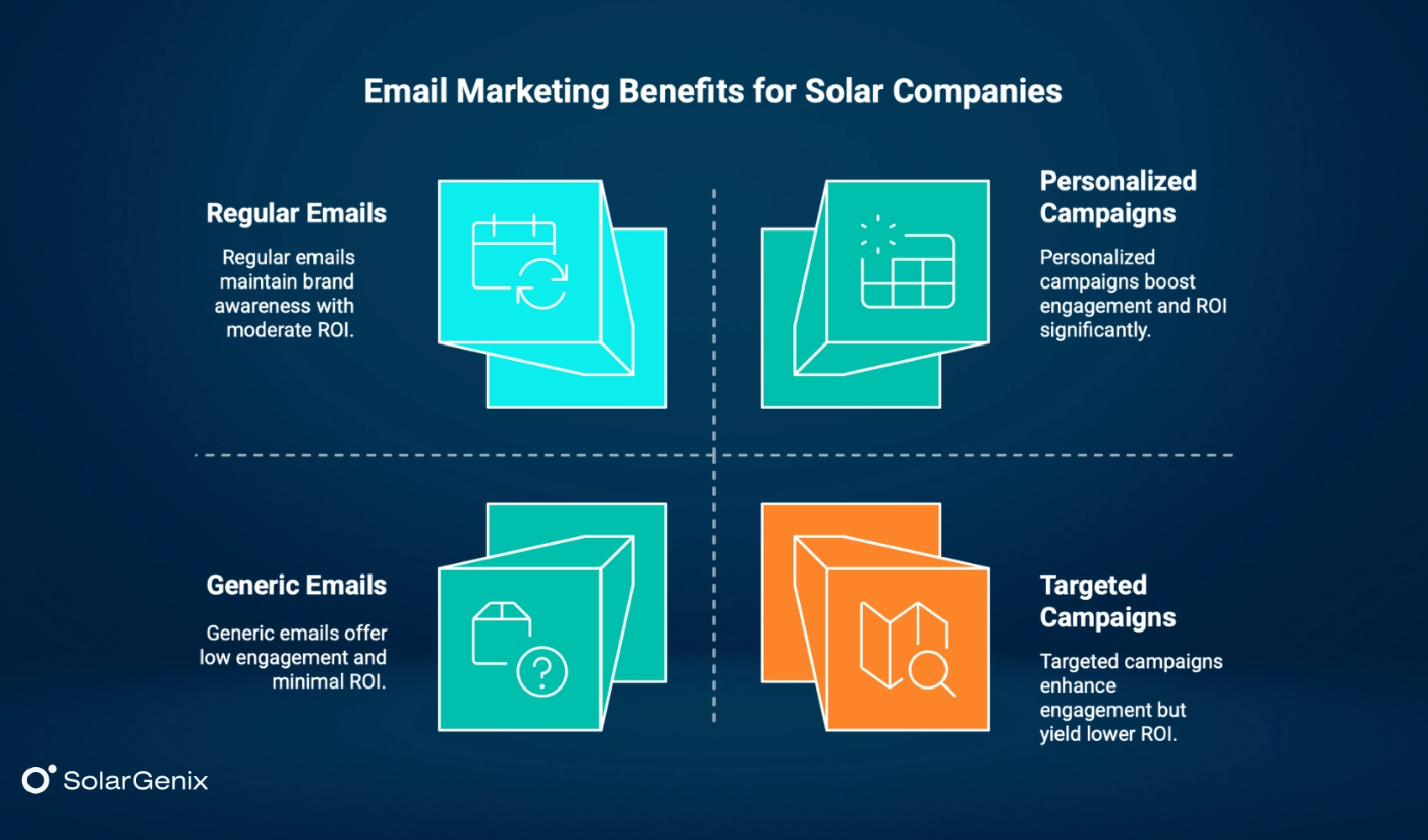
Email marketing fits perfectly well with the lengthy solar sales cycles. Emails can keep prospects engaged for weeks, and even months, as they do their solar research, consider financing options, and installation nuances.
Sending out regular emails, you’ll also maintain top-of-mind brand awareness. Homeowners may delay decisions but emails will keep your company in the back of their minds.
Emails deliver valuable results from the ROI perspective as well. According to different studies, the average ROI for email marketing varies from $36 to $40 for every dollar you spend on it. This comes in handy for solar companies with tight marketing budgets.
It’s not just the ROI that looks lucrative though. Let’s list a few other “good-looking” numbers:
- Email marketing campaigns can have an open rate of 22% on average. This is higher than the general average of 15%.
- Personalized and highly segmented email campaigns can bring a 39% higher click-through rate as opposed to more generic emails.
- A case study from SolarCity showed a 60% increase in customer engagement via targeted email campaigns.
Solar leads are more inclined to opening emails because they are curious to learn about the industry and the overall installation process before committing.
Build a Quality Solar Email List
Your solar email marketing journey starts with building a high-quality email list. There are several ways you can put this list together:
- Create landing pages for your specific offers.
- Use pop-ups but be mindful. Don’t annoy your visitors with them. Rather, have them come up at the right moments, for example, when a visitor is about to leave your website (exit-intent pop-ups) or has been looking around for quite some time.
- Offer downloadable guides on incentives or ebooks on “All Things Solar” in exchange for email addresses.
Use different types of lead magnets that will convince your website visitors to share their email addresses. Here are the most common ones:
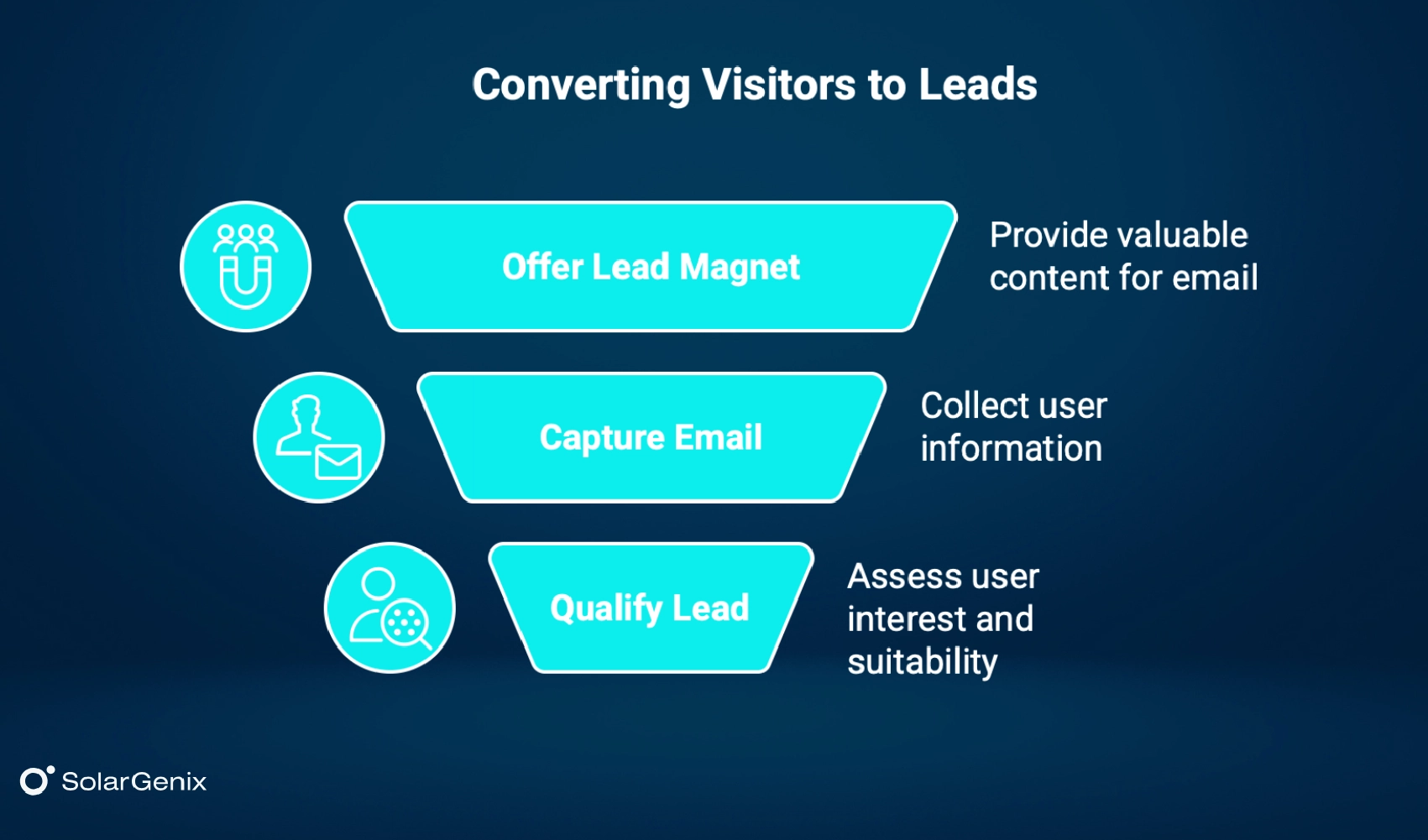
- Solar savings calculators will let homeowners input their electric bill and receive a potential savings estimate.
- Solar feasibility reports will help understand solar compatibility based on location, roof type, and shading, thus not only capturing user email addresses but also qualifying leads.
- Lead capture solutions, like the SolarGenix Lead Capture tool, will provide homeowners with such information as the most optimal way for panel placement on their roof, as well as an annual energy production estimate, monthly savings, 25-year savings, and more. In exchange, homeowners will be required to input their full name, email address, home address, and electricity bill.
Organic vs. Purchased Lists
You can always take the easy route and buy email lists. However, bear in mind that purchased lists often lead to spam complaints, low open rates, and overall poor deliverability. This can even damage your reputation.
Besides, in case of bought emails, recipients don’t give you their explicit consent to receive emails from your company, which can be a violation of GDPR and CAN-SPAM regulations.
On the other hand, organic email lists generate higher engagement and better conversions because you’re interacting with people who are genuinely interested in what you have to offer.
And once you have an organic email list, you can segment it, making it more targeted and personalized.
GDPR and CAN-SPAM Regulations
Make sure to stay compliant with GDPR and CAN-SPAM regulations. Have a clear and easy way to unsubscribe.
Include accurate sender information along with a physical business address and honest subject lines. Don’t forget that you need to have explicit opt-in consent from prospects.
Following these regulations will help you avoid legal issues and build trust with your subscribers.
Choose the Right Email Marketing Platform for Solar
An email marketing platform can essentially simplify your workflow and even result in better conversions.
Here are the main features you should look for:
- Automation capabilities to save your time and ensure consistency.
- CRM integration to ensure alignment with your sales team through lead information flow between systems and easy access to email engagement data.
- Analytics and reporting to understand what’s working and improve accordingly.
The most popular platforms for solar email marketing are as follows:
- Mailchimp
- HubSpot
- ActiveCampaign
- Constant Contact
To further enhance your email marketing efforts, we highly recommend that you choose a platform that enables integration with solar proposal software, like SolarGenix, and CRMs. This way you can automatically send follow-up emails once your leads receive proposals, track email interactions in your CRM, and dramatically reduce manual data entry.
And finally, take your budget into consideration when choosing a mailing platform. Mailchimp is quite affordable and can be the right choice for small businesses. Larger companies can go for more advanced platforms, like HubSpot or ActiveCampaign.
Write Emails That Solar Prospects Actually Open
Your subject line can be a deciding factor for your open rates. We’ve gathered a few subject line ideas to help you understand what actually works:
- Arouse curiosity by writing question-based subject lines, such as: “Is your roof solar-compatible?”, or ask a question about savings, incentives, etc.
- Offer value via subject lines that inform the homeowner about solar savings in their area or provide other location-specific information.
- Use number-based subject lines for quick and easily digestible information, e.g., “5 benefits of solar panels.”
- Create urgency, e.g., “Federal tax credit expires by year-end.”
- Write personalized subject lines, addressing the recipient directly, e.g., “Noah, your solar savings estimate is ready.”
Speaking of personalization, there are several ways you can make your emails more customized:
- Include the recipient name
- Use location data
- Reference energy usage or bill amount (if there’s been a prior interaction and you have this data at hand)
Timing
Mid-week mornings and early afternoons work best for B2C audiences. Sometimes, evenings can work too, 7-9 PM, when people are checking their emails after work.
Mobile Optimization
As already mentioned before, most people read emails on their phones. So, make sure to optimize them for mobile screens. Keep subject lines within the character limit, write concise paragraphs, and make CTA buttons large enough for thumbs to tap easily.
Quick Tip: Test every email on multiple devices before sending to ensure a smooth experience.
A/B Testing
And finally, A/B test your subject lines, preview texts, CTA buttons, and send times. You can split your list and send version 1 to one group and version 2 to the other, and analyze the results afterwards.
Write Email Content That Educates and Converts
Figuring out what type of content to share for solar email marketing can be tricky sometimes. Solar is a multi-layered and complex topic, so, pushy and selling emails won’t work. At the same time, solely educational content without any CTAs will fail too. You need to combine the best of both worlds.
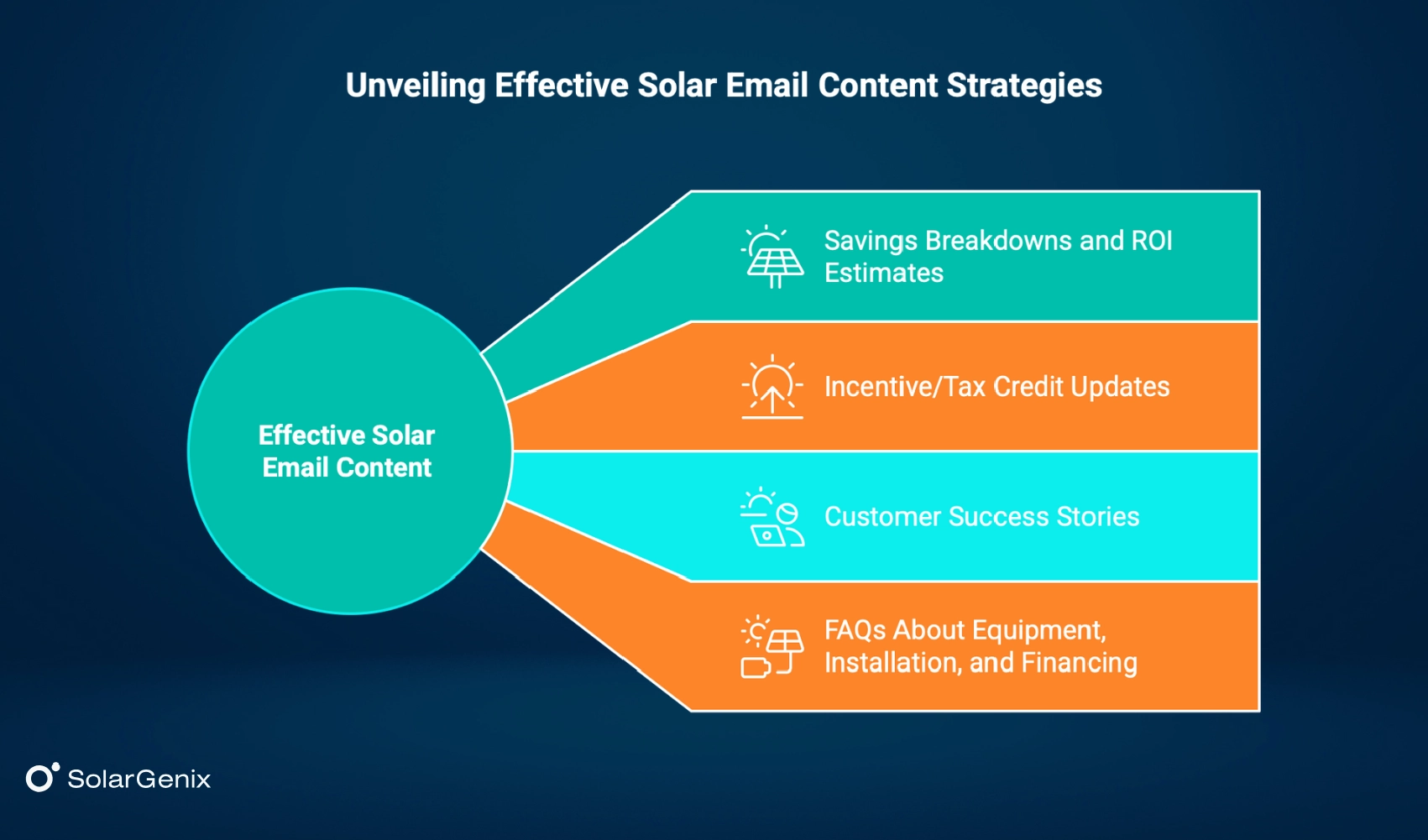
The most effective content types for solar email marketing are:
- Savings breakdowns and ROI estimates
- Incentive/tax credit updates
- Customer success stories
- FAQs about equipment, installation, and financing
How to Address Objections
Let’s first take a look at the most common objections that solar prospects usually have:
- High upfront cost or solar is too expensive
- Roof issues
- Payback period
- Home ownership doubts
Email is a good opportunity to address these objections in a low-pressure environment. For example, for the first objection, you can bring up financing options, incentives, and total cost of ownership comparisons.
If the issue is with the roof, let them know about different roof types and shading mitigation options.
For ‘payback period’, send them a detailed email about savings, accurate payback timeline, and long-term benefits in comparison with rising electricity bills.
As for the last one, you can handle it with information about how home value changes after solar installation.
Improve your content with storytelling techniques. Explain how real homeowners cut bills, gained energy independence, or eliminated their carbon footprint entirely.
CTAs
Your emails need strong CTAs in order to bring results. Include one primary CTA in every email, keep it clear, specific, and easy to act on. “Book a consultation” is much better than “Explore more.”
Use contrasting colors to make your CTAs stand out from the rest of the text. Position your CTA above the fold and at the bottom of your emails.
Include a secondary CTA in case prospects are not ready for a consultation. Offer an ebook or a calculator.
Design Professional Solar Emails That Build Trust
Email design is as important as its content. It should reflect your brand and show that you’re a trustworthy company.
The basic components of a high-quality email design include:
- Clean Layouts: Use a single-column layout for utmost readability across devices.
- Clear Hierarchy: Header styles, font sizes, and white space create a clearly structured email content.
- Branded Templates: Include your company logo, colors, and fonts. Keep this consistent.
Use visuals effectively to make your company real in the eyes of homeowners. The visuals in question can be:
- Home installation photos.
- System designs showing panel placement on the prospect’s roof.
- Infographics about year-over-year savings or system production.
Don’t pack your email with too many pictures. That will slow loading times.
Additionally, avoid spam triggers in your emails:
- All caps in subject lines or body text.
- Excessive exclamation marks.
- Too much bright red color in text.
- Repeated use of “FREE”.
- Too many images and an unproportionally short text.
Again, test emails across devices before sending and use responsive design techniques to ensure automatic adjustment of layout based on screen size.
And finally, make your text eligible for subscribers with disabilities. This can be done through semantic HTML structure, alt texts for images, color contrasts between text and backgrounds, and appropriate font sizes.
Create a Solar Email Drip Campaign That Nurtures Leads
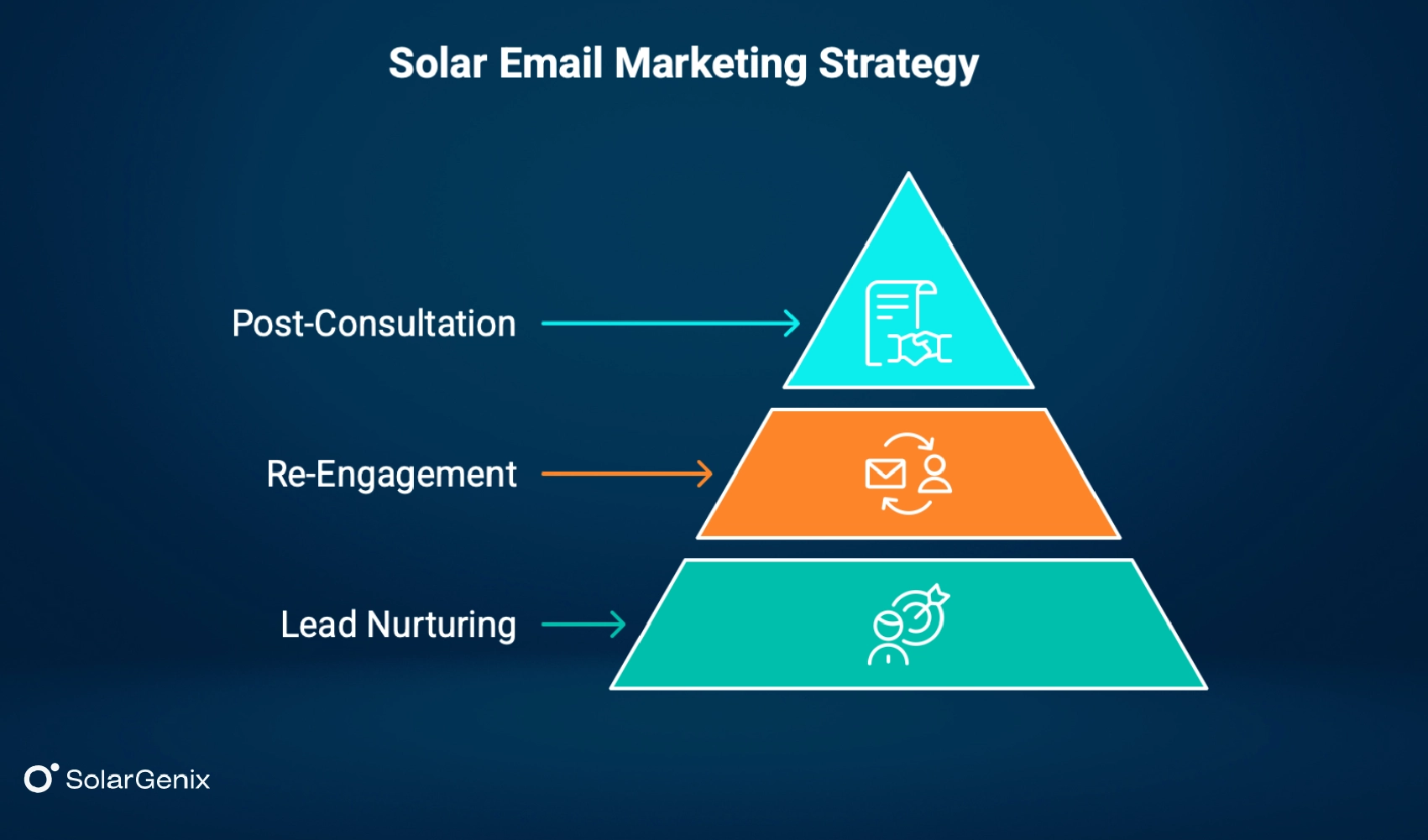
A drip campaign is a series of automated emails aimed at nurturing leads over time with intentionally timed messages. Drip campaigns are more like lighthouses for prospects throughout the buyer journey. The ‘drip’ content fits their stage of awareness and is directed at their specific concerns.
The best thing about drip campaigns is that they work automatically once set up. Thus, the actions of your leads don’t go unnoticed thanks to consistent follow-up.
Let’s have a look at a sample email sequence. The following campaign can be used for your new leads who’ve just expressed initial interest.
- Email 1 - an immediate email with a welcome message.
- Email 2 - 2-3 days later, includes educational content on solar.
- Email 3 - 4-5 days after email 2, introduces financial benefits, savings, incentives, etc.
- Email 4 - a week later, addresses common objections, displays testimonials, and answers FAQs.
- Email 5 - creates urgency using expiring incentives.
- Email 6 - asks directly to schedule a consultation call.
- Email 7 - a week later, in case the consultation is not booked, offers an alternative, like a phone call or a savings calculator.
Take your time with drip campaigns. At least 3-4 weeks. Sometimes, drip campaigns can last months.
Balance the timing between emails. Start with 2-3 days between early emails, stretch it to 4-7 days in the mid-sequence of the campaign, and 7-14 days for the last ones. If a promotion is running out, tighten the spacing.
Note: Keep an eye on engagement patterns. If your prospects are opening and clicking, and seem interested, you can send more frequent emails. However, if engagement drops, set the timing of emails further apart.
Re-Engagement Campaigns
No one said email marketing for solar was going to be easy. So, buckle up and let’s have a look at yet another lead nurturing opportunity.
Re-engagement campaigns aim to spark interest in cold leads.
Make a list of all the leads who have been ignoring your emails for 30-60 days and create a re-engagement email sequence.
- Start with a check-in: “Are we still relevant” or “Do you still want to hear from us?”
- Offer valuable information, such as sending updated proposals or new incentives, or your latest customer success stories.
- Don’t force anything. Try to reopen the dialogue while giving them a simple way to opt out, if they’re no longer interested.
- Ask them to fill in a quick survey to understand why they went cold.
- Offer them something smaller instead of expecting a full commitment. E.g., a free energy audit or a virtual consultation.
If you don’t hear back after 2-3 attempts, you can either remove them from your campaigns or move them to a low-priority mailing list.
Post-Consultation Follow-Up
Post-consultation follow-up campaigns serve as the middle ground between a prospect meeting your team and signing a contract with you.
Here’s an optimal email sequence you can use at this stage:
- Email 1 - send this a few hours after the consultation call, include a ‘thank you’ message and summarize everything that’s been discussed.
- Email 2 - send this 1-2 days later, include the proposal and financing or warranty details.
- Email 3 - this should be a follow-up, 3-4 days after the previous email, asking the prospect if they have any questions.
- Email 4 - send this one a week after email 3 with a customer story that would hit home with the prospect in question.
- Email 5 - create urgency.
- Email 6 - a direct question about moving forward with the installation.
You can keep going until you hear a clear acceptance or rejection from the prospect. Keep your late-sequence emails 7-10 days apart and always provide valuable information.
Segment Your Email List for Better Results
Segmentation helps you better understand what type of content to share for solar email marketing. It helps you be more intentional with your emails and makes your prospects feel that you actually care about them.
When you divide your email list into specific groups based on shared characteristics, you’re able to personalize messaging, offers, and timing.
You can segment your email lists by:
- Location
- Average bill amount
- Buyer journey stage
- Roof type or home eligibility
You can also do behavioral segmentation. Follow your prospects’ email engagement patterns and send better targeted follow-ups. Some people open your emails but don’t click, others click but never book, some become cold over time - the patterns can be countless. Figure out ways to engage with these groups differently - some need more convincing with more compelling offers, others need objection handling or re-engagement emails.
Make sure your campaigns are highly targeted and focused on the different motivations of each group. Customers who pay extremely high bills, need to hear about savings. Environmentally conscious people want to know how they can reduce their carbon footprint. Stay conscious of the values of your prospects and you’ll be able to reach them.
And finally, use automated tools, like CRMs, or advanced platforms like HubSpot or ActiveCampaign to make segmentation easier for your team.
Use Automation to Save Time and Stay Consistent
Solar email marketing can’t be quite as successful without proper automation tools. You don’t want to spend your time and efforts on tedious and repetitive manual tasks. Instead, you can have a system that works for you in the background, sends consistent follow-ups, and ensures timely communication.
Solar companies have to manage numerous leads at a time. Automation makes sure none of them is lost.
So, what can you automate in your solar email marketing processes?
- New lead nurture sequences.
- Consultation preparation emails and automated reminders after appointment bookings.
- Proposal follow-ups. These are sent automatically when prospects receive quotes.
- Occasional check-ins.
- Trigger-based emails. Common triggers include an abandoned quote, promised post-webinar resources, anniversaries that remind customers of their installation anniversary, providing them with maintenance tips or referral requests, birthdays that can be used to offer special deals, and inactivity for re-engagement campaigns.
- Drip campaigns for long-term nurturing and education.
Leverage Customer Testimonials and Case Studies in Email
Handle the “trust issues” of your prospects graciously. What better way to do that than through real customer reviews and testimonials?
Provide reassurance that solar is a long-term investment in building a better future.
How to Collect and Format Customer Stories for Email
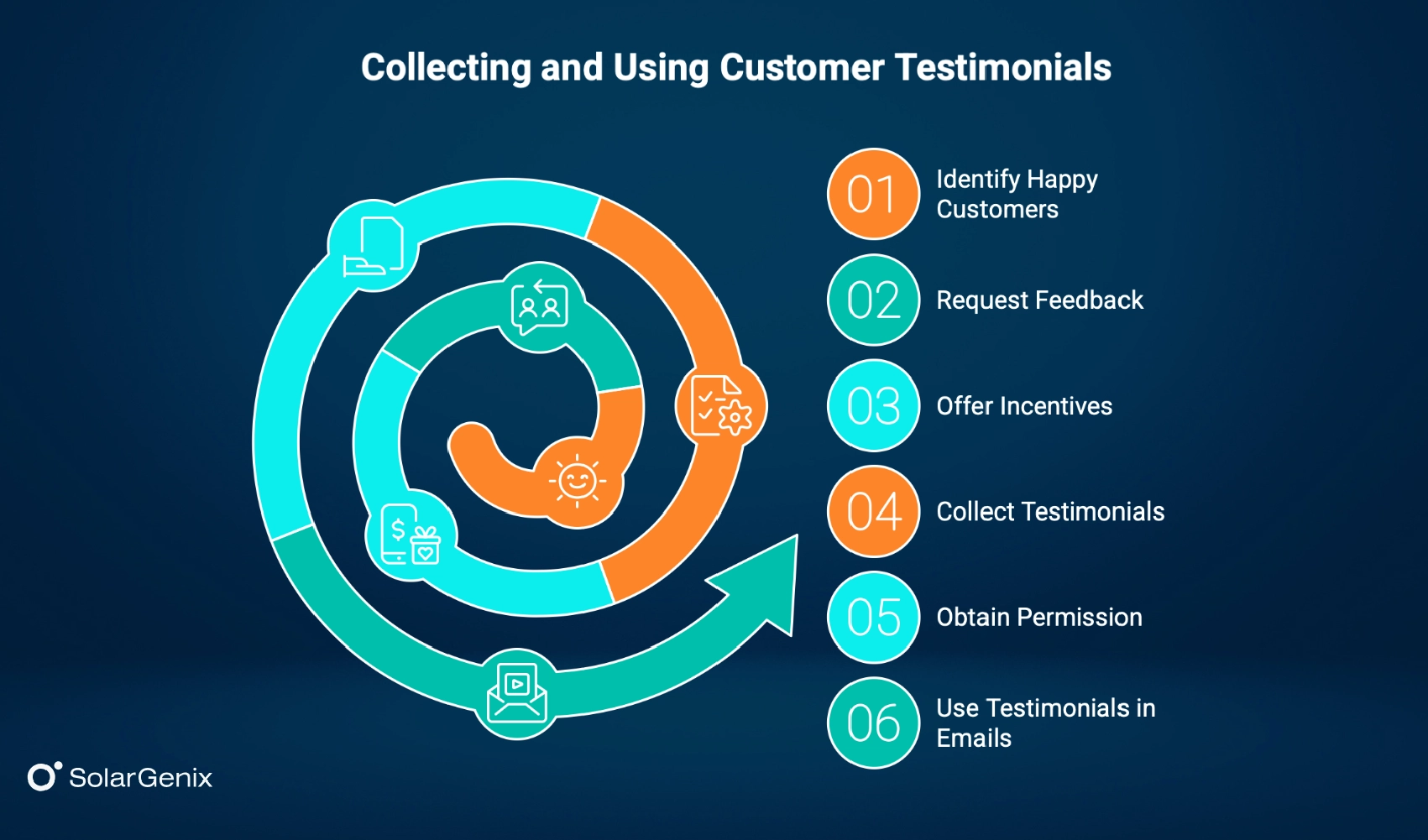
Happy customers are your main source of testimonials. Request feedback 2-3 months after the installation. Make the process easy. Include simple forms with specific questions about their experience, how they decided to go solar, and what advice they’d give others.
You can even offer gift cards or referral bonuses to get detailed testimonials. Many clients are even willing to shoot video testimonials. Use this chance as well.
Don’t over-edit written testimonials. Keep the authentic voices of your clients.
Don’t forget to get explicit permission for using the testimonials with names, photos, and other details.
We have a few ideas how you can use testimonials in your emails:
- Include before-and-after pictures (of bills, the system).
- Add quotes about savings or overall experience.
- Include video testimonials.
- Use local stories for better targeting and relevance.
Promote Limited-Time Offers and Incentives Through Email
Creating urgency will lead to action, if handled correctly. It’s a strong motivator because it often results in loss aversion where people fear missing out on an opportunity - the notorious FOMO.
If your prospects are interested but somewhat lazy, you can use urgency to push them to make a final decision.
The main ways to create urgency through solar email marketing are:
- Expiring federal tax credits
- Local utility rebates
- Seasonal offers, such as end-of-year incentives, summer energy savings, etc.
When doing this, don’t get carried away. Keep things ethical. Don’t ever manipulate or provide false information.
- Include clear deadlines
- Be transparent about incentive changes
- Provide real-time eligibility updates
Don’t exaggerate. Don’t be pushy. Be delicate and make it easy to respond to your urgency emails.
Track Email Performance and Optimize for Better Results
As they say, data is the new oil. Use your email performance data to fine-tune and improve your campaigns as you go.
Here are the main metrics to track and monitor:
- Open rate shows the effectiveness of your subject lines, timing, or list quality.
- Click-through rate (CTR) reflects the success of your CTA and content relevance.
- Conversion rate shows the amount of people who acted on your CTAs, e.g., booking a consultation, downloading a resource, etc,
- Unsubscribe rate helps you understand whether your emails are too frequent or poorly written.
- Bounce rate shows the quality of your email list.
To get all this data, you need to use analytics from your email platform or CRM.
Results from a single campaign can be misleading. We recommend that you look for patterns across several campaigns. If your open rates are low, test a different subject line or choose different send times. If CTRs drop, change the formats of your email content, position CTAs differently, or change design elements.
For best results, test one element at a time. This way, you’ll get clearer insights.
Additionally, set realistic benchmarks for each list segment separately. Open rates for cold reads differ from those for warm or hot leads.
Avoid Common Solar Email Marketing Mistakes
Mistakes are common and natural in email marketing for solar. However, you can avoid them if you know what they are.
Let’s have a look at the most common ones:
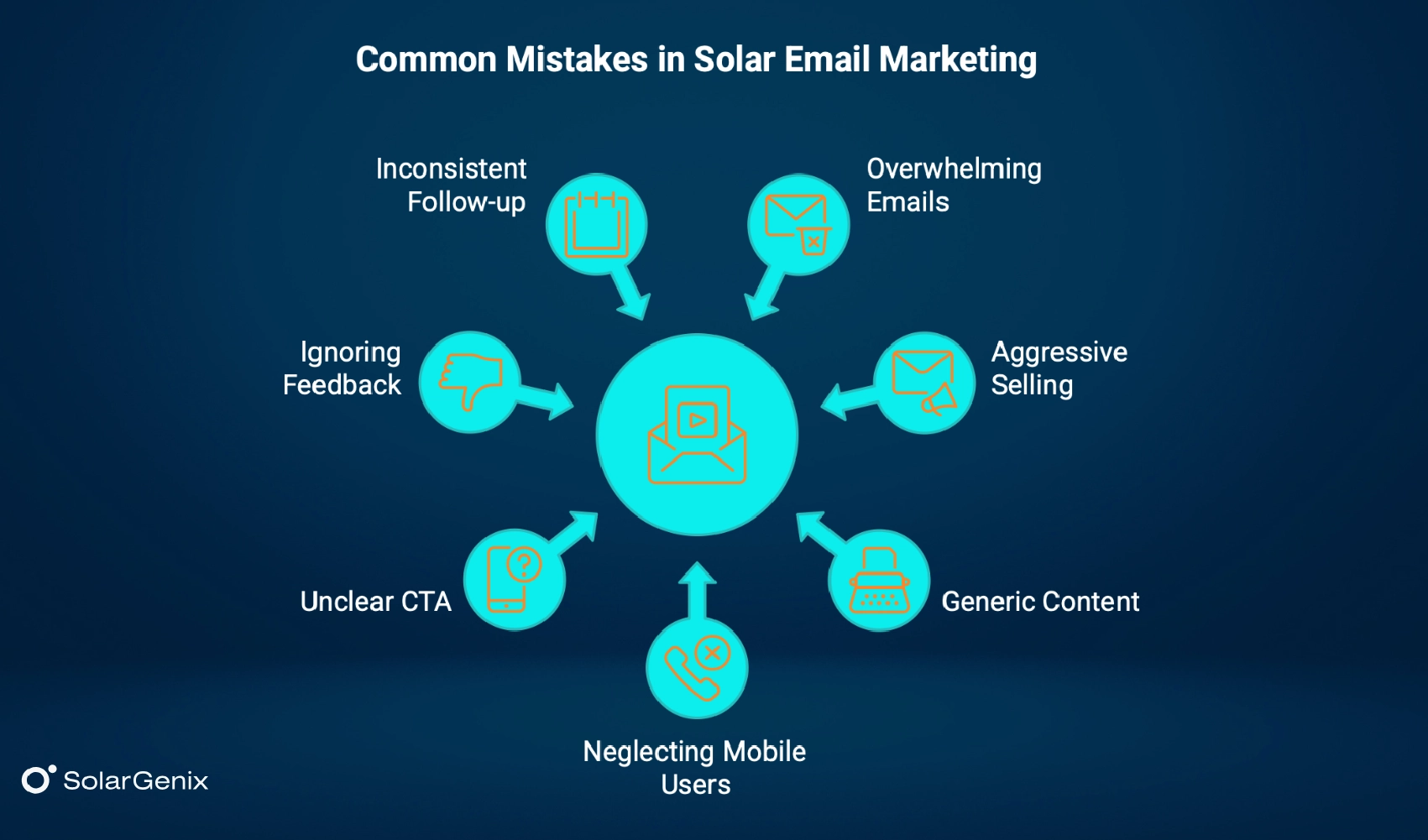
- Sending too many emails and overwhelming your prospects will only lead to more unsubscribes.
- Aggressive selling without educational value. People want to learn about solar. They won’t buy blindly. Solar is a huge investment for an average homeowner.
- Generic, non-personalized and non-segmented content feels impersonal, and makes you look unprofessional and untrustworthy.
- Neglecting mobile users can cost you lots of qualified leads. Around 46% of emails are opened on mobile devices. Moreover, about 50% of users will delete emails if they don’t display properly on mobile. So, make sure your emails are mobile-friendly for people who check their emails on phones.
- An unclear or missing CTA is a waste of an email.
- Ignoring unsubscribers and complaints can damage your sender reputation and even lead to legal issues.
- Inconsistent follow-up results in prospects forgetting about you or losing trust in your company.
Integrate Email Marketing with Your Overall Solar Sales Strategy
Email marketing works best when you combine it with other marketing and sales processes.
Coordinate emails with:
- Phone calls
- Texts
- In-person visits
You can send recap emails after phone calls or proposals after site visits. Use both text and email for appointment reminders or expiring incentives.
Use email marketing to:
- Prepare homeowners before consultations and they’ll be more engaged during the call.
- Follow up after proposals, while they’re still highly interested, and lead them slowly towards full commitment.
- Support referral generation via post-installation check-ins and referral bonus offers.
- Align seasonal campaigns across email, social media, and paid ads to achieve greater impact.
Tools and Resources to Improve Your Solar Email Marketing
Let’s recap all the tools and resources you can use to improve your solar email marketing efficiency:
- Email marketing platforms with solar-specific features. Check out ActiveCampaign or HubSpot. The latter comes with integrated CRM.
- CRM tools that sync with email campaigns to ensure consistency across your sales process.
- Solar proposal software that generates shareable email-ready proposals. SolarGenix offers one of the best and fastest solar proposal generation solutions. You receive a well-structured, detailed, and personalized proposal with neat design, ready to be shared via email.
- Analytics and reporting tools will help you have an in-depth look at your marketing campaign metrics and effectiveness.
- Templates and resources for solar emails can cut your work in half. Don’t start from scratch. There are enough solar email templates and helpful materials available and ready to be adapted to your brand.