When it comes to delivering a solar sales pitch, making mistakes can cost you customers. Oftentimes, solar reps fail to close deals not because they offer poor-quality products, but because they make a sales pitch that doesn’t connect with homeowners on an emotional level.
Our guide will walk you through the process of crafting a persuasive solar sales pitch, from drafting your message and understanding your audience to handling objections and closing.
Knowing how to deliver the best solar sales pitch will help you engage with the right homeowners and move them into the next stages of your sales process, where continuous education, follow-up, proposals, and solar design software all work together to help people switch to solar.
Key Takeaways
- Residential solar sales require education and building rapport, not technical persuasion.
- Structuring your solar sales pitch with a clear hook, problem statement, solution, social proof, and a CTA will keep homeowners interested to learn more.
- Addressing objections with empathy helps build trust and minimize resistance.
- Storytelling tactics and visual aids make your pitch both memorable and credible.
- Personalizing your pitch for different buyers can highly improve conversion rates.
- Creating ethical urgency drives homeowners to take action without coming across as pushy.
- Consistent follow-ups after the initial pitch are essential to achieving closed deals.
What Makes a Solar Sales Pitch Different?
In solar, you’re selling outcomes, not features.
When deciding to go solar, homeowners are guided by emotional and financial factors.
Emotionally, homeowners look for security, control, and convenience for the whole family. They also want to be more environmentally conscious or be seen as innovators in the neighborhood.
Financially, they want savings, solid ROI in the long run, increased property value, and being untouched by utility rate spikes.
Know Your Audience Before You Pitch
The best sales pitch for solar panels is built on thorough research. The better you know your customer, the more personalized your pitch is.
So, gather all the information you can:
- Monthly electricity bill and usage patterns
- Roof type, shading, and orientation
- Possible motivations (saving money, sustainability, simple curiosity, etc.)
You can also customize your pitch during the process by asking relevant questions.
We recommend asking one or more of the following questions:
- What prompted you to look into solar?
- What’s your biggest concern about switching to solar?
- What interests you most: the environmental benefits or the financial ones?
These questions show that you want to solve their specific problem, not just sell.
And last but not least, read the room. Pay attention to eye contact, body language, and engagement cues. Adjust your pitch accordingly based on the signals you get.
Structure Your Solar Sales Pitch for Maximum Impact
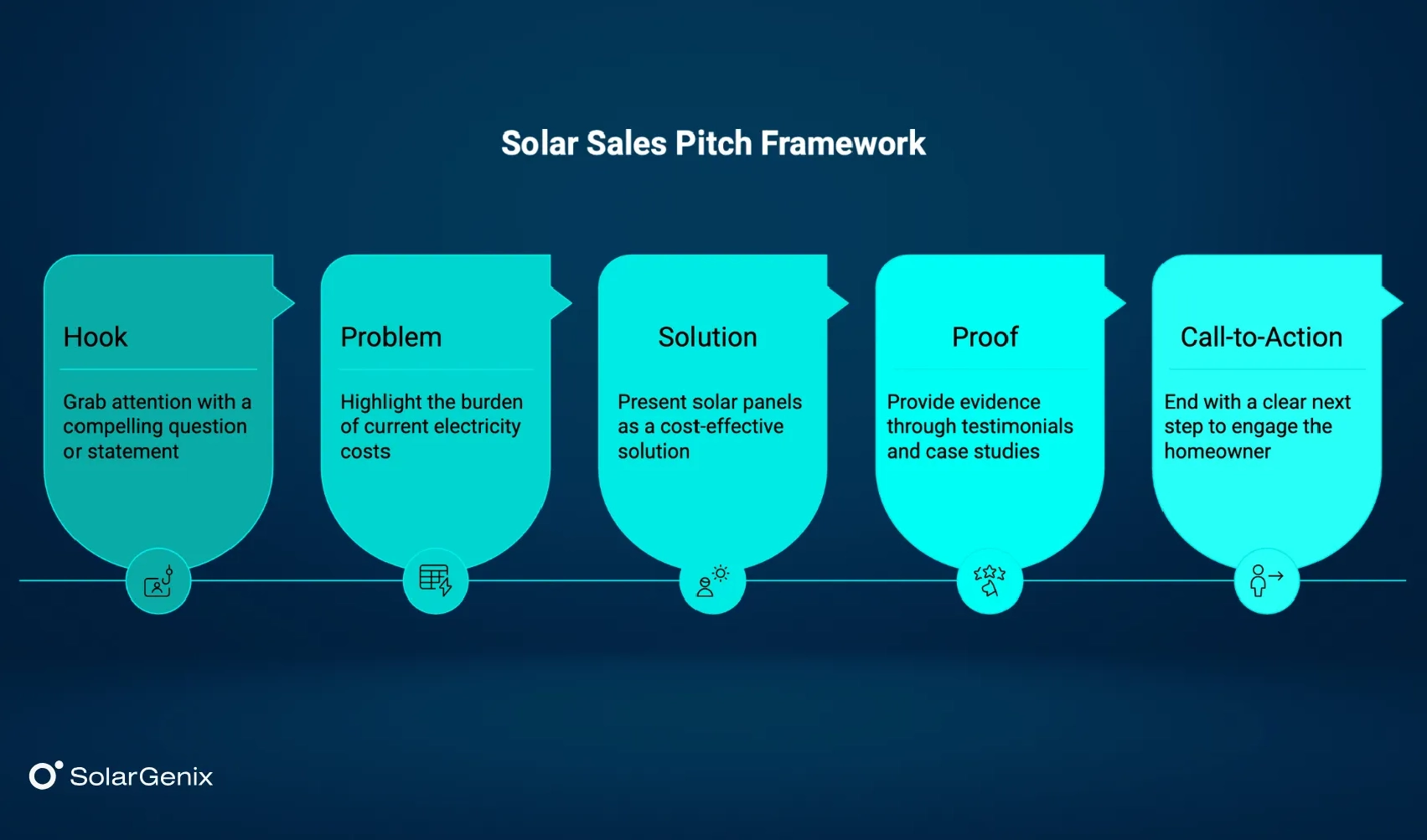
A strong solar panel sales pitch usually follows this framework: Hook → Problem → Solution → Proof → Call-to-Action.
Let’s break things down in more detail.
The Hook
The hook needs to be well-thought-out to grab attention immediately. You can start with a question, e.g.: “Did you know that utility rates increase 3-5% every year?” Or with something like: “What would you do with an extra $150 every month for the next 25 years?”
The Problem
The problem should help homeowners feel the burden of their current situation. Show them how much they have spent on electricity in the past 5-10 years and predict the amount they will spend in the next decade.
Example: “It won’t be long before your yearly $1,500 bill becomes $2,000-$2,700 in a few years.”
The Solution
The solution is where you take the stage as a solar representative. State the benefits of solar, from monthly savings to energy independence and ROI. You can even show them how solar panels would look on their roof and explain energy production.
Example: “Our systems let you lock in a stable energy cost, releasing you from being at the mercy of utility rate increases year after year.”
Social Proof
Back up your claims with clear evidence. Showcase customer testimonials, reviews, and case studies from similar homes. Example: “We’ve helped [number] homeowners in your neighborhood cut down their electricity costs and they regret not doing it sooner.”
In an ideal scenario, you could bring up a local homeowner example: “Nancy and Mike down the street went solar recently, and they’re already reaping the benefits of lower electricity bills.”
Call-to-Action
End your pitch with a clear and specific next step. Try to create some urgency, if possible. Depending on where the homeowner is on their solar journey, you can use different CTAs.
Here are a few examples:
- “Let’s schedule a meeting to look at your options and financing plans.”
- “We can send you a detailed proposal with all the solar savings and energy production calculations for your roof specifically, and set up a meeting to discuss your financing options.”
- “If everything looks good to you, we can go ahead and set up an installation date for you.”
- “We have a few installation slots left this month and if you book now, you can benefit from the current incentives and tax credits.”
Note on Building Rapport: As you start your pitch, don’t jump into numbers right away. Try to engage in a genuine conversation to build trust and lower resistance. The best solar sales pitch feels like a dialogue, not a monologue.
Timing Matters
A solar panel sales pitch can last anywhere from 20 to 40 minutes.
However, it’s not the overall length of the pitch that matters, it’s the first impression that sets the tone for the rest of the conversation.
Follow the 3-30-3 rule.
- 3 Seconds: You have 3 seconds to get the attention of the homeowner, so work on making your hook as compelling as possible.
- 30 Seconds: This is where you should deliver value. Explain the benefits and how these benefits solve their problems.
- 3 Minutes: If the person stays engaged for 3 minutes, it means you’ve successfully broken the ice. At this point, the odds of converting have gone up essentially and you can provide them with a full, more thorough solar sales pitch.
Lead Your Solar Sales Pitch with Benefits, Not Features
Don’t fill your pitch with technical jargon and solar panel features, like panel wattage, inverter brands, or monitoring systems.
Homeowners want to know about the positive changes that solar will bring to their lives.
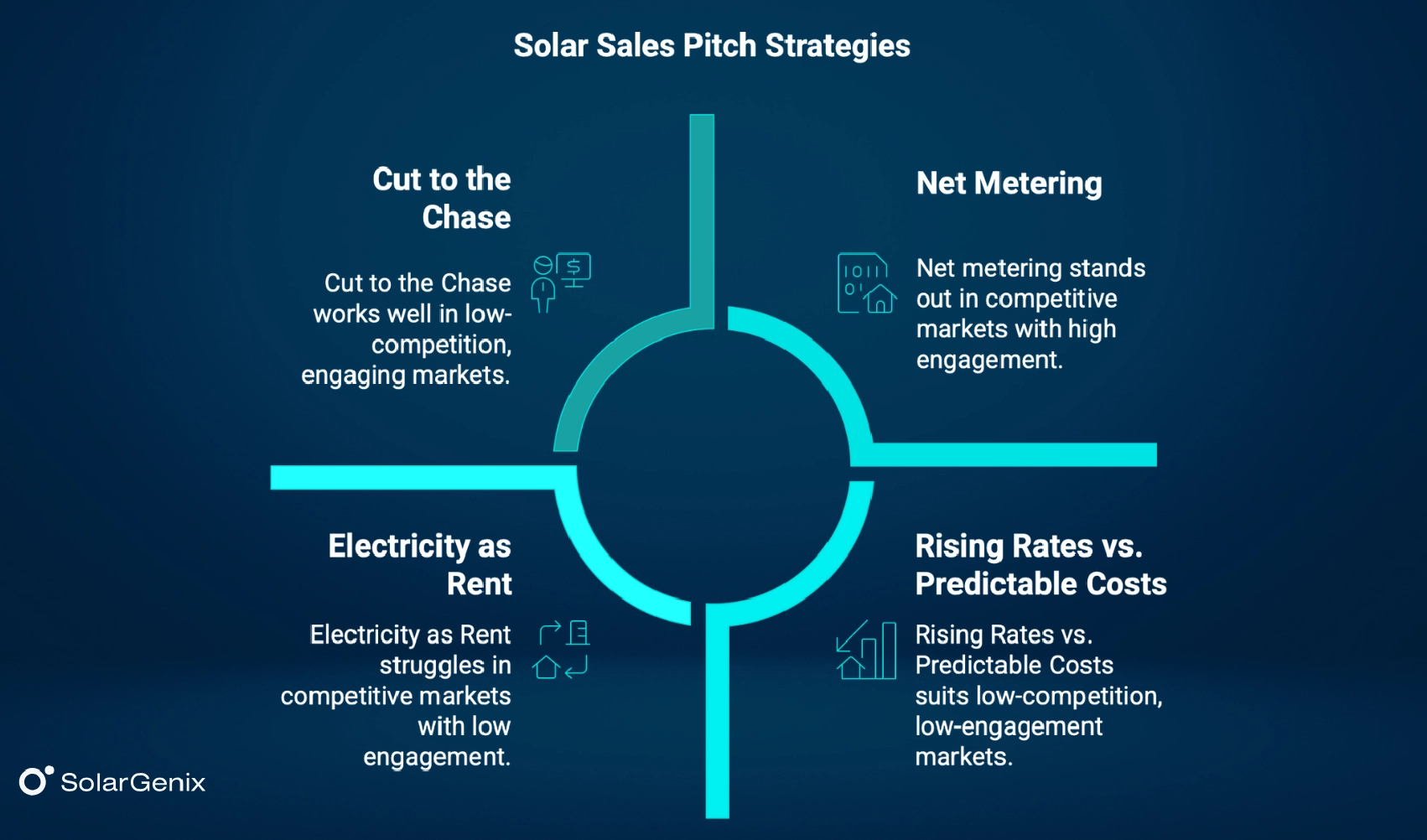
Here’re the main types of solar sales pitches:
The Net Metering Solar Pitch
It’s more difficult to interest homeowners when they’re being approached by different solar companies all the time.
The net metering method can help you stand out in a highly competitive market.
Example:
“Hello, I’m reaching out to you about the new energy credit program. Your neighborhood is also involved. They’ve upgraded your meters and your new meter now lets you earn credits when your home produces extra energy. This can actually help you reduce your bill. Is this something you’d like to know more about?”
If net metering succeeds in sparking curiosity, you can then go ahead and introduce solar: “Solar can be of immense help here. You can produce your own electricity, use what you need, and get credits for what’s left unused.”
The “Electricity as Rent” Pitch
“Think of your electricity bill like a monthly payment for a home you’ll never own. What if you could own your electricity, just like you own your home? Solar helps turn monthly payments into an investment in your own energy and independence.”
This is a strong motivator. Most homeowners know the value of a “room of their own” as compared to paying rent to someone else.
All you have to do is project the same concept onto solar panels and electricity.
The Rising Rates vs. Predictable Energy Costs Pitch
This pitch is for people who care about financial benefits and long-term investments.
Example:
“Electricity bills have been climbing, haven’t they? We offer a way to stop the continuous unpredictability. Let’s see if your home qualifies for a solar program that will keep your monthly bills predictable for years to come.”
The “Cut to the Chase” Solar Sales Pitch
You can get straight to the point in markets that haven’t been heavily approached by solar companies yet.
Example: “Hi, I’m helping people in your neighborhood switch to solar and take control of their energy bills. Want me to show you how much you can save with solar?”
Use Storytelling to Make Your Solar Pitch Memorable
“The best arguments in the world won’t change a person’s mind. The only thing that can do that is a good story.” - Richard Powers, American novelist
Stories create an emotional connection that statistics cannot match. Try to share a narrative about a real customer’s solar journey and you’ll create space for homeowners to see themselves in that story.
Compare these two pitches:
- “Our clients save an average of $1200 a year.”
- “Last month, we worked with the McCallister family just across the street. Their electric bill used to reach as much as $280 in the summer because of the pool pump and the AC. Initially, they were skeptical about solar, but 6 months later, they couldn’t be happier with their decision to install solar panels. Their bill has dropped to $23. Now they can spend the money they save on electric bills on things that matter more.”
The first one is valid and persuasive. No doubt about that. But the second one creates an emotional connection and a memorable image in the homeowner’s mind.
Approach Homeowners with Empathy
Never dismiss homeowners’ concerns.
For example, if the homeowner is worried about the high upfront cost, you can answer:
“I totally understand. High upfront costs can seem intimidating, especially for a long-term investment like solar panels. The good news is that you can go solar with little to no money down.
There’re multiple financing options we can look into and choose the one that suits you the most. Besides, the system usually pays for itself over time by reducing or eliminating your electric bill. I can run a quick calculation for your home so you can see the real savings, both short- and long-term.”
The structure is simple:
- Accept and validate their concern.
- Offer a solution.
Sell through stories and care. When sharing a testimonial or a case study, don’t say: “I have a relevant case study to share with you.” Rather, integrate the story organically into the conversation: “You know, you remind me of another homeowner I worked with last year who had the same concern…”
Show, Don't Just Tell: Visual Aids That Strengthen Your Pitch
Combine your stories with pictures and you’ll be able to deliver the best sales pitch for solar panels.
There’re multiple different visual tools you can use:
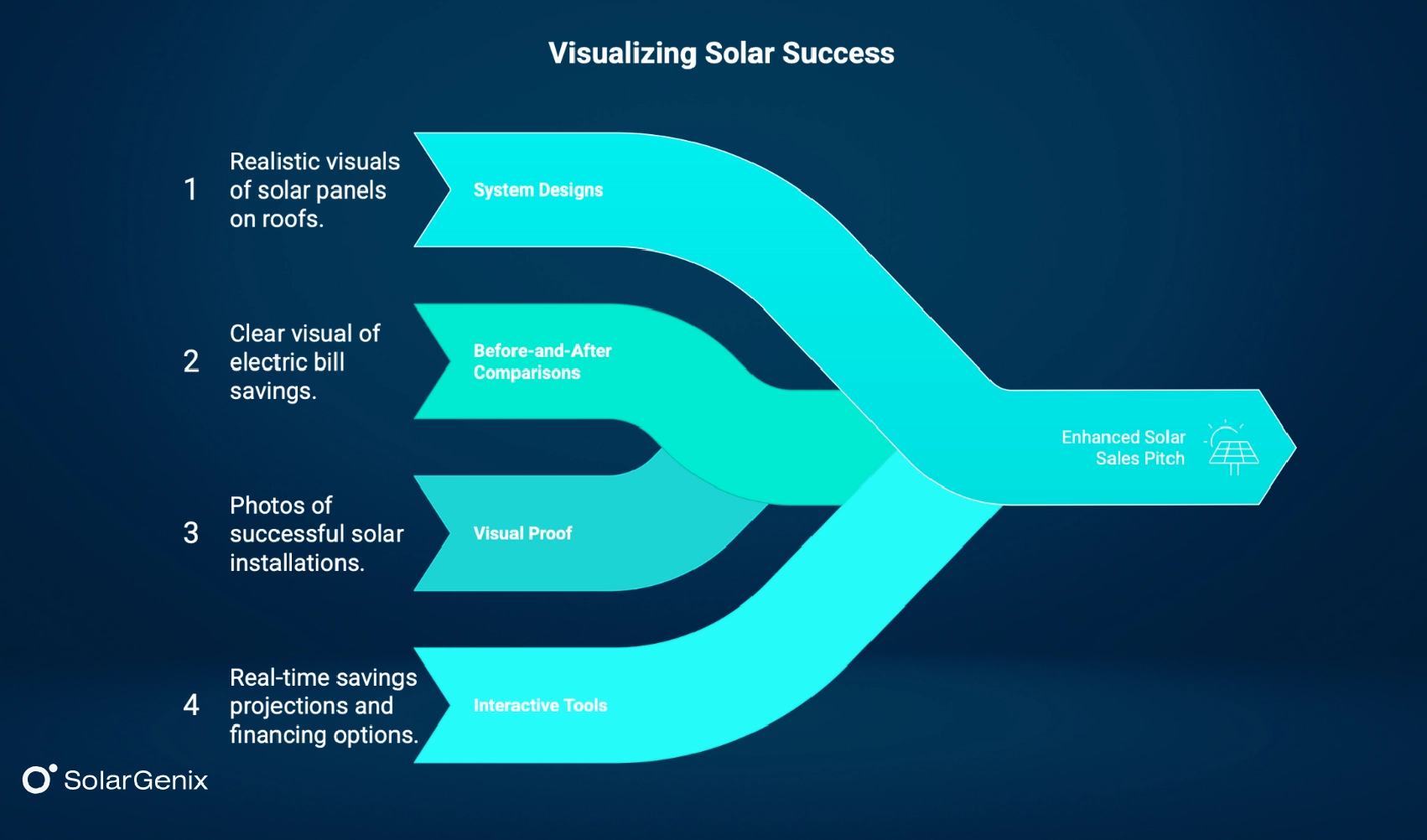
- System Designs and Roof Layouts: Modern solar design software, such as SolarGenix, allows you to create realistic visuals of what the solar panels will look like on the homeowner’s roof.
- Before-and-After Comparisons: Show a clear visual representation of the homeowner’s current annual electric bill, with a projected 3-4% annual increase, and compare how the numbers change once they switch to solar. Provide monthly savings along with 25-year savings.
- Visual Proof: Have photos of completed installations to complement your customer success stories.
- Interactive Tools: Use solar calculators and proposal generation software, like SolarGenix, to deliver real-time savings projections and offer different financing options.
Before you go, leave something for the homeowner. It can be a proposal or a one-pager with savings calculations.
Present Pricing and ROI with Confidence
Pricing discussions can be quite challenging unless you know how to approach them strategically.
The key is to present price in combination with savings and ROI.
Let’s say the solar system costs $25,000. Here’s how to include this in your pitch:
“The total cost sounds overwhelming, however, if you finance it with zero down, your monthly payment would be around $105 over the next 20 years. And what’s more important, you’ll own the system eventually. Now compare that to your current $200 electricity bill that keeps increasing every year. With solar, you’re saving money from day one.”
Another way to put it would be:
“So, you’re currently spending around $2400 per year on electricity. With solar, that number comes down to zero. Over the span of 25 years, you’ll have saved $60,000 in utility costs. And to achieve such savings, you need to invest $25,000 before incentives. After incentives, the number will essentially drop. Basically, you get a 100% ROI, all the while increasing your home value by 4%-10% ($15-20,000). How does that sound to you?”
Address Objections Before They're Raised
We already displayed how you can address the “high upfront cost” objection. Let’s now look at some other common objections:
Roof Condition
Many homeowners worry that their roof needs to be replaced before panel installation.
“We do a detailed roof inspection before installation, and if we detect issues or see that your roof is unfit for solar, we’ll let you know upfront. Most roofs in good condition last 25-30 years with solar panels. Moreover, panels protect your roof from weather damage.
However, if we find out that your roof does indeed need to be replaced, we’ll connect you with trustworthy roofing companies and be here for you when you’re ready for installation.”
Weather Conditions
There’s a misconception that solar doesn’t work well in cloudy and wintry climates.
“One of the most common myths about solar is that it only works in sunny locations. That’s not true. Solar panels generate electricity from daylight, not direct heat from the sun. This means that they work perfectly fine on cloudy days, just at a slightly reduced output.
We size your system based on your location’s weather patterns and average sunlight, so the annual production estimates are as accurate as possible.
Moreover, because they’re angled and absorb heat faster, panels don’t hold snow long.”
Maintenance
Maintenance costs are another reason behind homeowners’ resistance.
“Solar panels require almost no maintenance. You don’t have to worry about changing any moving parts or filters, or providing regular servicing.
If your town or city is particularly dusty, you can rinse the panels with a hose once or twice a year.”
Warranty
25 years is a long time. It’s natural for homeowners to worry that your company might not be around in 10-20 years.
“We assure you that your warranty will be in effect for as long as it’s been promised. Your panels have a 25-year manufacturer warranty directly from [Manufacturer], which is an industry leader. Your inverters have a 25-year warranty from [Inverter Company]. So, it’s not just us who stand behind your warranties. Plus, we provide a 10-year workmanship warranty on our installation. We’ve been in business for X years, have worked with X amount of customers, and installed X systems. You’re safe with us.”
Create Urgency Without Being Pushy
Create urgency but keep it ethical.
You can do this by using:
- Expiring tax credits
- Seasonal promotions
- Limited installation slots
- Rebate deadlines
- Utility rate increases
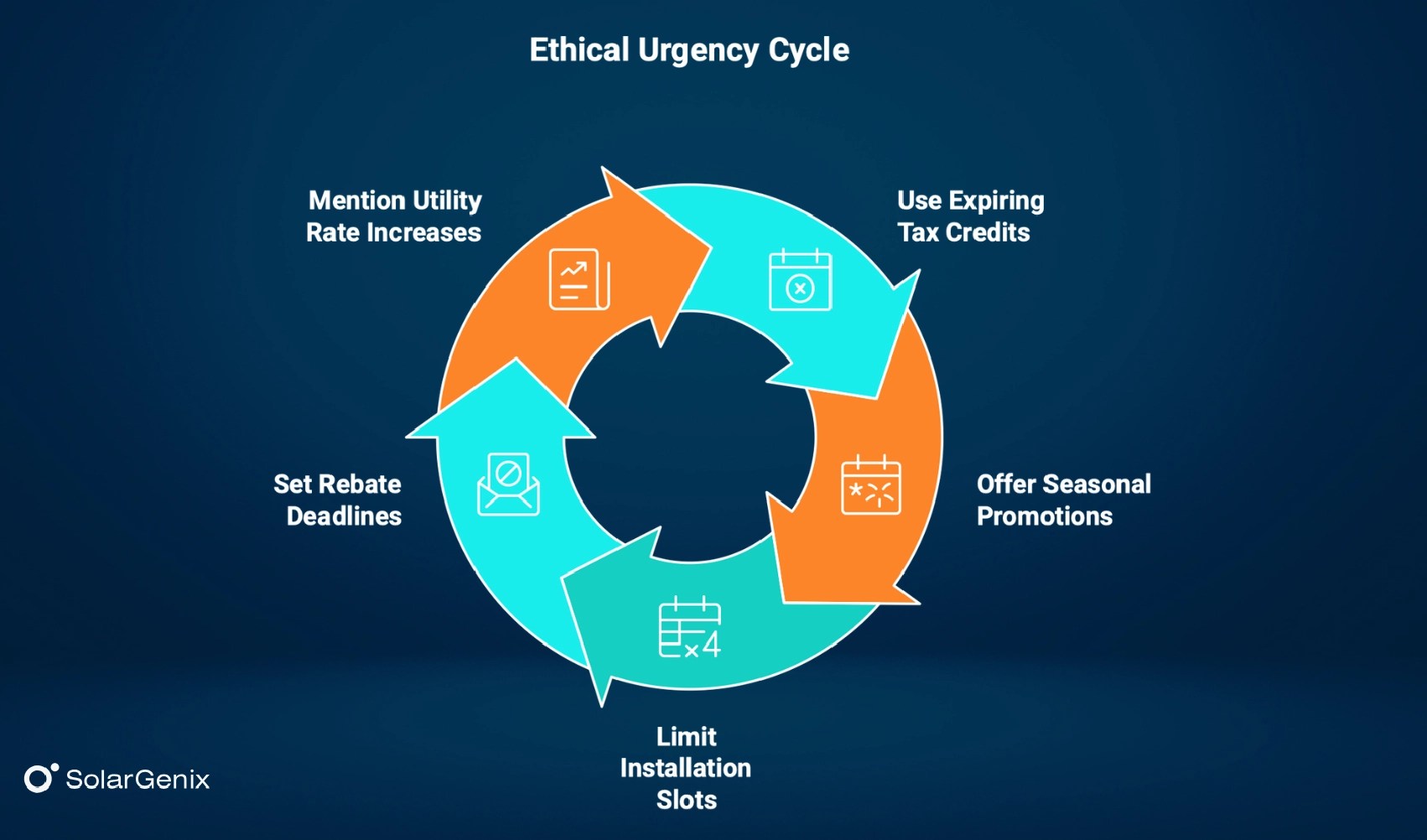
Let’s look at an example:
“If you want to benefit from the state solar rebate program, it’s better to book your installation spot now. Last year, the program ran out of money by August. If the funding runs out before we’ve processed your application, you’ll lose the money.”
Adjust Your Pitch to Different Solar Buyer Types
Determine the buyer persona. Different buyers require different approaches:
- Analytical buyers focus on data, logic, and ROI. Give them numbers, from payback period and savings to annual energy production and financial options. You can start with: “If you compare your utility costs for the coming 20 years vs. owning a solar system, solar starts saving almost immediately. I can calculate the exact numbers for your home.”
- Eco-conscious buyers want to know how going solar would help them reduce their carbon footprint. For example: “Switching to solar equals taking two cars off the road.”
- Budget-conscious buyers want to see the numbers right away. Show them a clear comparison of their current bills and the monthly savings of solar, payback period, and ROI. Use the same approach as the one for analytical buyers.
- Skeptics are hard to crack. They worry about costs, risks, contracts, company reliability - pretty much everything. Provide extensive proof, testimonials, and examples of neighbors who switched. E.g., “Those are fair concerns. Many homeowners feel the same way at first. That’s why we’ll walk you through real numbers and real examples from your neighbors who’ve already gone solar.”
Master the Close: Asking for the Sale
There are two ways you can end your solar sales pitch.
Use the soft close technique if you want to be more subtle, understanding, and relationship-focused with your prospect.
Example: “Does our solar solution make sense for you?” or “What would you need to feel comfortable moving forward?”
The hard close technique employs a more assertive and direct approach, often creating a slight urgency.
Example: “The current incentives are already available. Do you want to secure them today?”
Practice and Refine Your Solar Sales Pitch
The best sales pitches for solar panels aren't created overnight. They come with experience, regular practice, testing, and refining.
- Keep things clear and concise. No jargon.
- Use visuals.
- Practice handling objections.
- Test different hooks.
- Get feedback. Record yourself and pitch to a colleague.
- Adjust based on past experience.
Avoid These Common Solar Pitch Mistakes
We all make mistakes. It’s natural. The key is to recognize them and never repeat again, especially in a complex process like solar sales.
Here’re the common mistakes solar reps make in their sales pitches:
- Talking too much and not listening.
- Too many technical details.
- Skipping the rapport-building stage.
- Being vague about pricing and financing.
- Failing to address concerns and objections proactively.
- Failing to nudge the homeowner to take action.
- Leaving without a clear next step.
Follow Up After Your Solar Pitch
Don’t expect to close a deal in one meeting. Remind the homeowner of yourself afterward.
There’re a few ways you can follow up after the pitch:
- A recap email, including everything you discussed during the pitch.
- A quick check-in to answer questions you may have missed during the pitch.
- A clear next step. It can be another call, site visit, proposal review, or a decision date.
Example:
“I wanted to summarize everything we’ve discussed so far and remind you how solar can reduce your electricity bill and lock in a fixed rate.”
Wait a couple of days before sending the next email with a clear CTA.
Example:
“Hi there. Just checking in on you to see if you’d like to set up a meeting and discuss your proposal in more detail.”