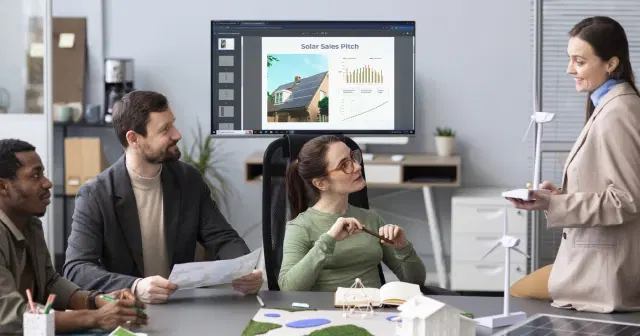
In 2026, door-to-door solar sales will remain one of the most effective sales channels for residential solar companies. There’s no doubt that digital marketing is and will always be a huge source of solar leads; however, D2D puts sales reps right in high-intent neighborhoods where many homeowners are already interested in renewable energy options.
Besides, door-to-door solar panel sales offer immediate feedback loops: you learn about objections from homeowner to homeowner and understand what messaging resonates the best. Additionally, you can use solar design software to quickly assess system size and show homeowners the right panel placement for their roofs right on the spot.
And finally, you build your local market share and position your company as a trusted solar provider in the area.
In this guide, we’ll walk you through the whole process, from checking local rules to closing your meeting, so you can plan your next in-person meeting with a homeowner better and avoid the common mistakes.
Key Takeaways
- Compliance, permits, and “No Soliciting” rules must be followed.
- Choose neighborhoods strategically. Aim for those with high homeownership rates, solar-ready roofs, and high utility costs. Do a pre-walk session.
- Avoid backtracking and cover one side of a street at a time.
- Use friendly openers and buy more time as you go.
- Qualify before proceeding with an appointment booking.
- Save complex solar explanations for the consultation.
- Validate objections and offer solutions confidently.
- Send quotes within 4 hours and follow up 2-3 times within the first two weeks after your visit.
Check Compliance First: Permits, Allowed Hours, and “No Soliciting” Rules
First things first, you need to ensure you’re allowed to operate legally in your chosen neighborhood or town/city. Many cities require solicitation permits for selling solar door-to-door, and some even limit the hours you can knock. The most common practice is prohibiting visits before 9 AM or after 8 PM.
There are neighborhoods that hang “No Soliciting” signs at entrances or on individual doors. If you ignore these signs, you’ll end up having to pay fines, getting complaints, and eventually harming your company’s reputation.
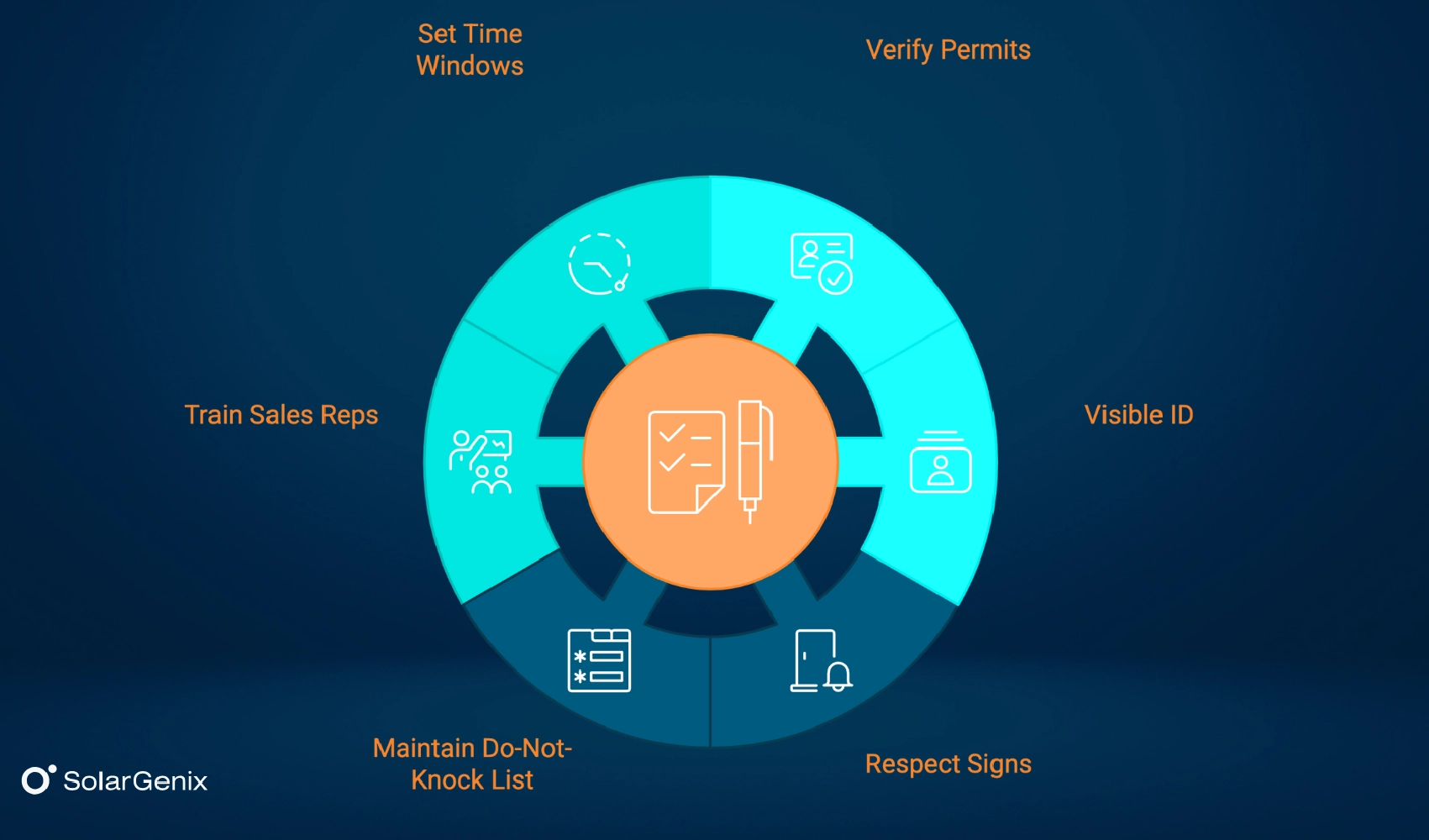
We recommend that you follow this quick checklist to ensure compliance with local laws and to show integrity:
- Verify permit requirements in each city/county you plan to do door-to-door canvassing.
- Keep your ID visible. It can be a company badge or a permit number if required.
- Respect posted signs. Don’t be intrusive and don’t knock on doors with “No Soliciting” or “No Trespassing” signs.
- Maintain a do-not-knock list of addresses in your CRM to avoid repeat visits.
- Train your sales reps on local laws and regulations. Make sure they are aware of any specific disclosure requirements or cooling-off periods. The latter does not apply to all states.
- Have clear time windows for door-to-door visits, e.g., 10 AM-7 PM on weekdays, 11 AM - 5 PM on weekends.
Being aware of local rules will help you avoid legal issues, wasted time, and help you build trust in your target neighborhoods.
Pick an Ideal Target Neighborhood: Knock on Doors That Convert
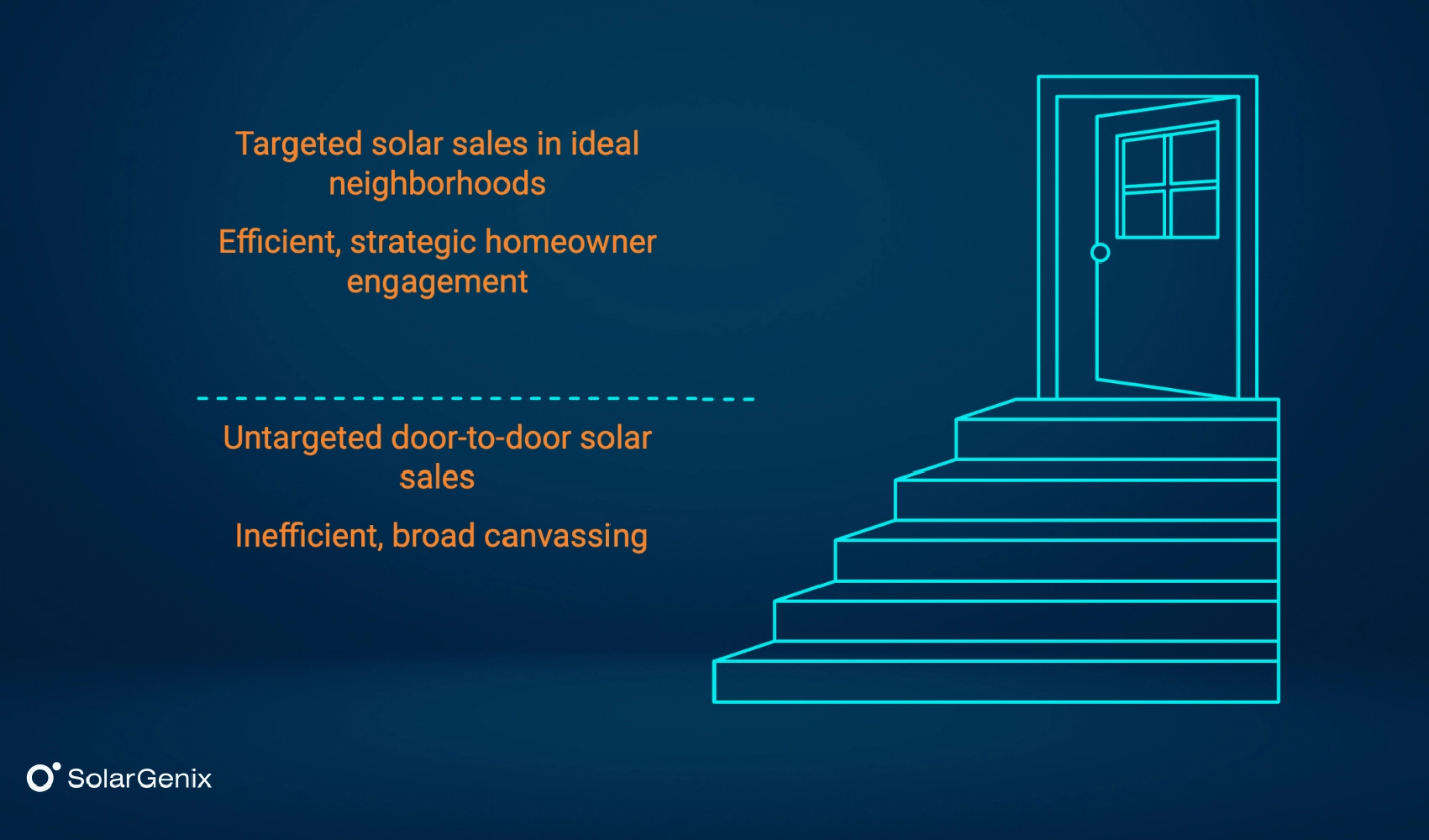
When learning how to sell solar door-to-door, it’s important to choose the right neighborhood.
Here are a few key traits that “solar-friendly” neighborhoods share:
- High homeownership rates. You don’t want to waste time in rental-heavy streets.
- Solar-ready roofs. Such roofs are usually south- or west-facing with minimal shading, and in good condition.
- Consistent roof types. This means that homes are built similarly, and you can do faster quoting.
- High utility cost areas that will make solar savings sound more attractive.
- Recent home sales. New homeowners often switch to solar because they reassess their bills.
- Visible EV chargers in driveways mean the neighborhood is open to innovation.
- Daytime occupancy patterns, e.g., people working from home or retired couples. Otherwise, you’ll need to do your visits on weekends.
Pre-Walk Routine
Let’s now go through a pre-walk routine that you can follow before knocking on doors. This will help you get mentally sharp, logistically ready, and approach homeowners more strategically.
Here’s how to lay the groundwork for winning in selling solar panels door to door:
- Drive or walk around the neighborhood, paying attention to roof conditions, shading, existing solar installations, and “No Soliciting” signs.
- Note EVs, new landscaping, new HVAC units, or recent renovations. These are signs of financially active homeowners.
- Detect cul-de-sacs and corner lots because these homes often come with larger roofs.
- Identify 5-10 homes that you’ll visit first.
- Make sure that your gadget (laptop, iPad, etc.) and the software you use are working properly.
Doing a quick scan like this will help you plan better, prioritize homes, and avoid wasting time on streets with uninterested homeowners.
Plan Your Route So You Don’t Waste Half the Day
Efficient routing can double the door count for any door-to-door solar salesman.
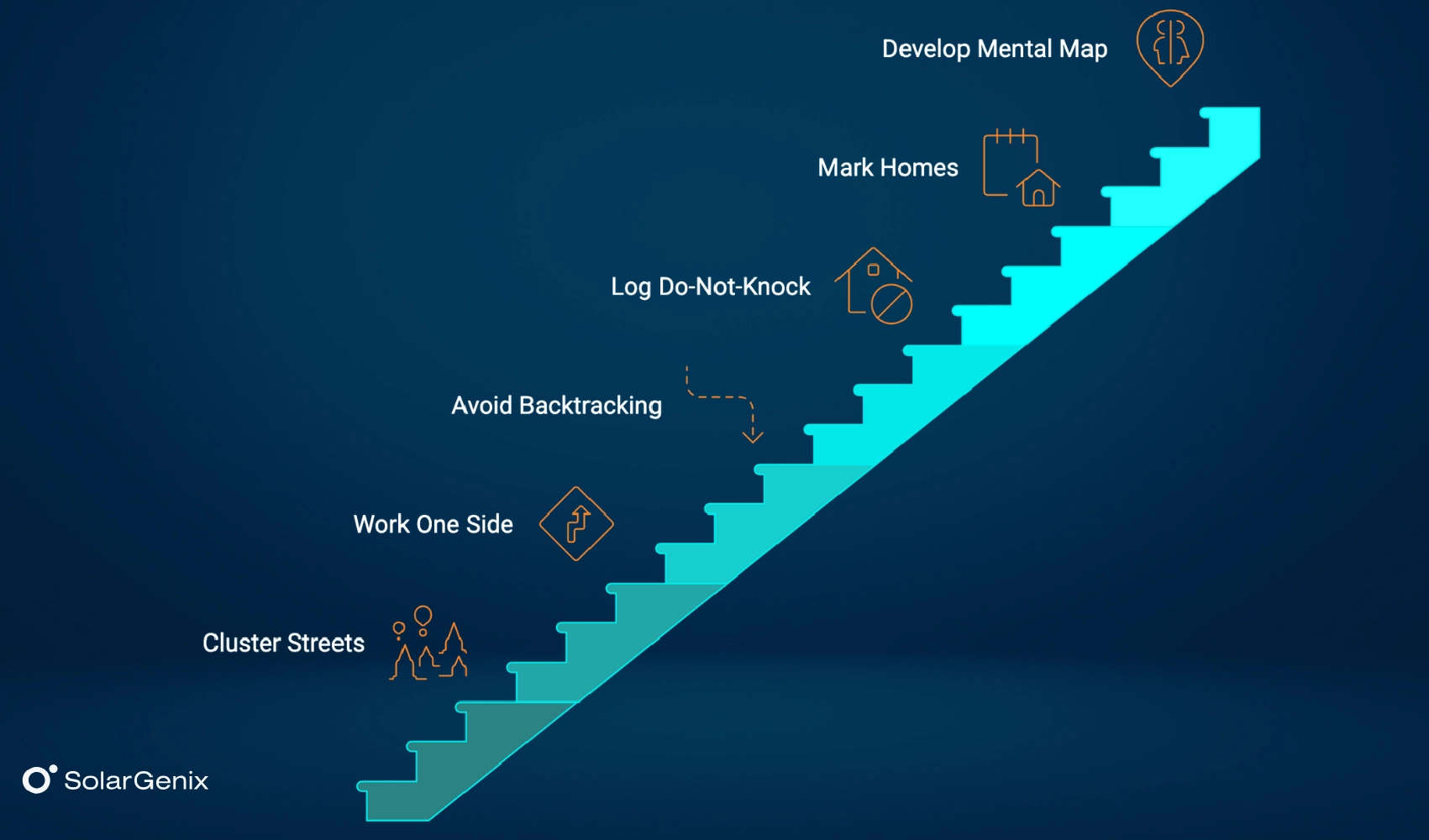
If you’re wondering how to plan your route in the best way, read our recommended action plan below:
- Don’t jump from neighborhood to neighborhood. Rather, cluster streets within one neighborhood.
- Work on one side of a street at a time. If a homeowner isn’t home, take note of the address and come back later.
- If possible, don’t do backtracking to save time.
- As mentioned earlier, log do-not-knock homes in your CRM right away.
- Mark homes clearly to avoid confusion later, for example, “not home” or “not interested.”
As time goes by, you’ll be able to develop a mental map of your target neighborhoods, which will help you do the door-to-door solar panel sales more efficiently.
Use Effective 20-Second Doorstep Openers
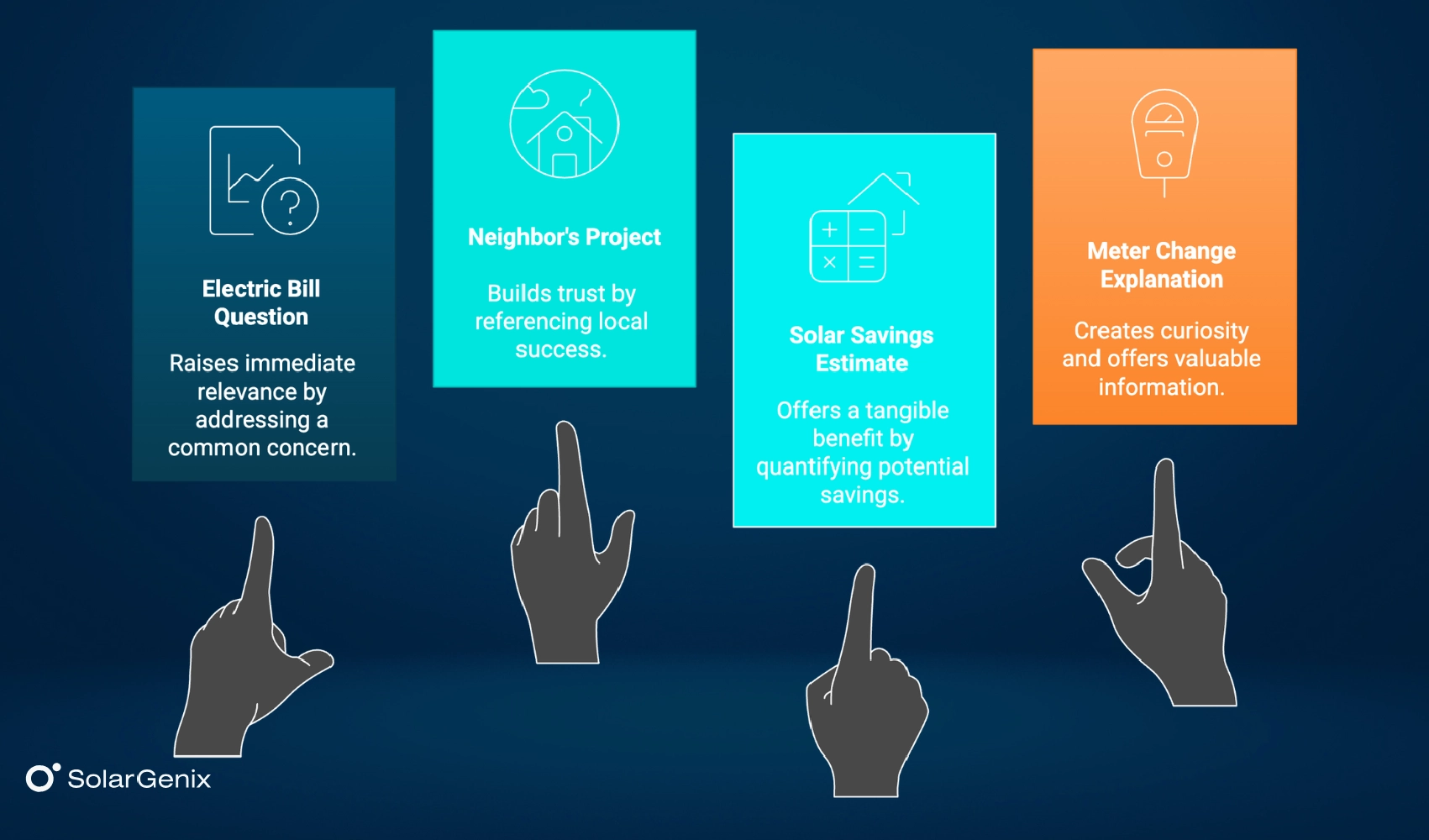
Your solar sales pitch can be the reason why the door you knock stays open or shuts in your face. As a solar sales rep, you need to be personable, open, friendly, and non-salesy; at least, not in an aggressive or pushy way.
Always be conscious of the homeowner’s time, show how solar is relevant for their specific neighborhood, and create curiosity. Adjust your pitch based on their answers, instead of going by the book. It should feel like an engaging conversation, not a monologue.
Let’s now look at a few effective doorstep openers to get you started:
- “Hi there. Quick question. Have you noticed your electric bill going up this year?”
- “Hello. I’m [Name] with [Company]. I was just working with your neighbor, Adam, on a solar project, and I wanted to stop by and see if you’d be interested in a quick energy estimate for your roof. Are you the homeowner?"
- "Hi there. I noticed you haven’t switched to solar yet, but a few homes on the street have. Would you like a quick estimate of solar savings based on your current electricity bill?"
- "Hey there. Have you noticed that they changed your meter a while back? Do you know how it changed the way credits work? Mind if I explain it in 30 seconds?”
The most important thing is to be patient and not to frustrate homeowners with your door-to-door sales pitches. Be mindful of your tone, energy, and overall approach.
What to Avoid?
Keep in mind that your main goal is to add up more time with every sentence you say. A single wrongfully chosen word or phrase can scare away the homeowner.
We suggest that you avoid the following when communicating with homeowners:
- Long and overwhelming explanations about solar.
- Starting with financing and contracts right away.
- Sounding too scripted and not engaging in a conversation.
- Ignoring body language and being too assertive, while they’re obviously uninterested. Rather, ask for a better time to visit.
The first 20 seconds aren’t about selling. They’re about getting permission to continue.
Qualify Fast: Ask Questions Before You Offer a Time Slot
Door-to-door solar sales are a lengthy process. This means that you don’t want to waste time on people who are just chatting without real buying intent. You need to qualify prospects early and move only serious homeowners deeper into your solar sales funnel.
While homeowner qualification usually happens during the actual visit, you can narrow down your list beforehand. The above-described preparations, from choosing homeowner-heavy neighborhoods to checking roof conditions and “No Soliciting” signs, will do this for you.
This pre-walk routine, however, will help you understand where to knock, but not who will buy.
The real lead qualification happens at the door, usually during the first 2-3 minutes. This time allows you to confirm:
- Homeownership
- Presence of decision-makers
- Interest in solar and lowering electricity bills
- Electricity bill range
- Roof suitability
You can ask the following questions to learn these details:
- “Do you own or rent the home?” or “Are you the homeowner?”
- “Do you remember how much you paid for electricity last month?” or “What’s your average monthly electric bill?”
- “Have you done any recent roof work? Do you know how old your roof is?” and “Does your roof get good sun, or is there a lot of shading?”
- “Are you planning to live in this home in the coming years?”
- “Do you make energy decisions on your own, or is there someone else involved, too? Maybe your spouse?”
- “How interested are you in solar? Are you thinking of switching this year?”
If they don’t pass all or most of the checks, don’t be pushy or too assertive. Leave them a card and move on. However, if they do qualify, go ahead and schedule an appointment.
Set the Appointment the Right Way
The truth is, you can’t educate homeowners about solar at the door. That’s too complex a conversation that can kill momentum and overwhelm the homeowner. At this point, your goal is to schedule a specific time and date, either virtual or in-person, for a proper, detailed explanation of solar.
Here’s how you can ask for an appointment when selling solar door to door: “I don’t want to rush things for you here. What we usually do is run a quick savings check and walk through it together. Would tomorrow evening or Saturday afternoon work better for you?”
Get their phone number or email address, then send a confirmation email, message, or a calendar invite (for online appointments) within 15 minutes.
Answer Objections Without Sounding Pushy
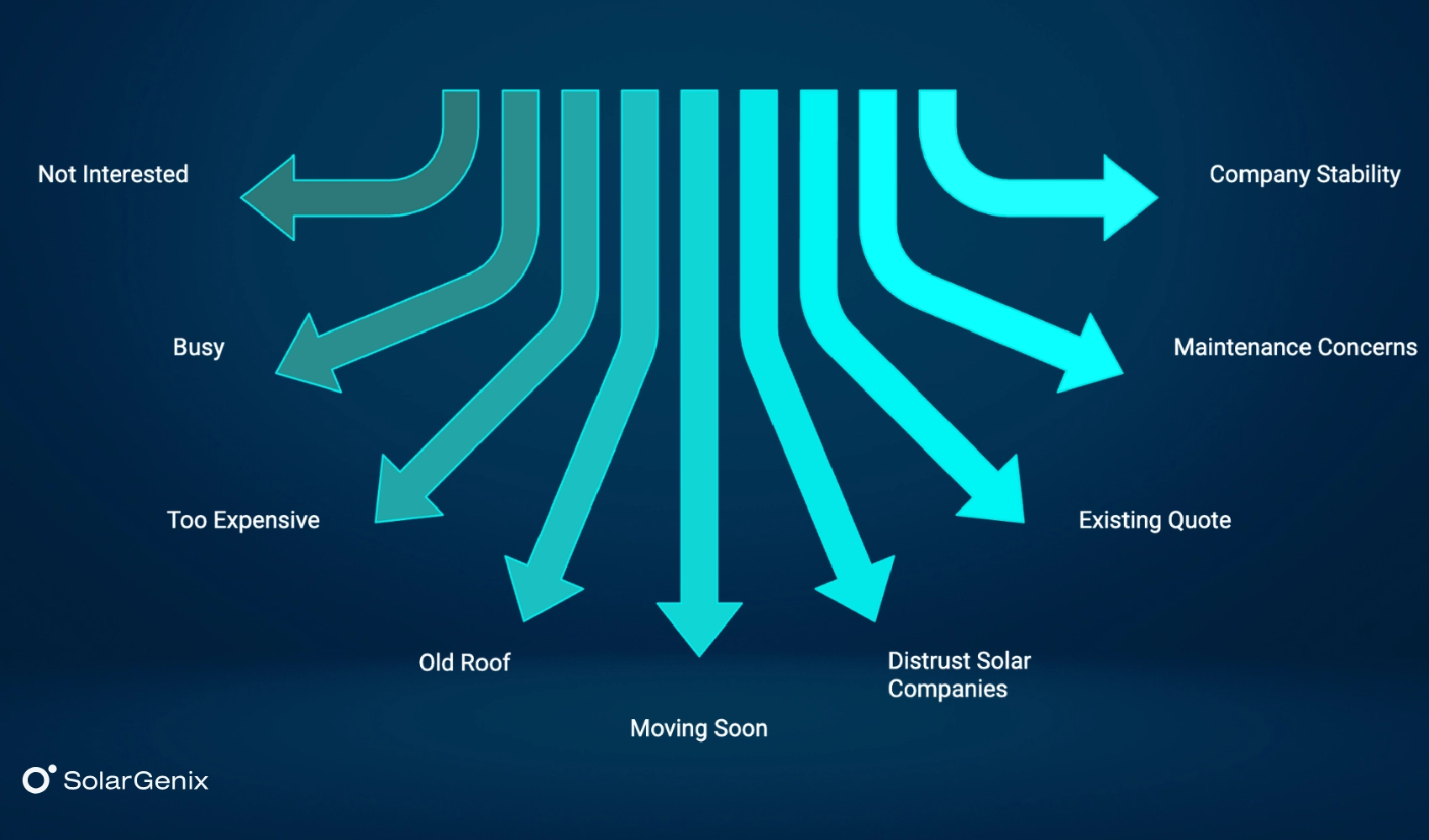
How you handle objections determines the results of your door-to-door solar panel sales. Stay calm, validate their concerns, and offer a solution to each.
Let’s go through the most common objections along with responses that will help you build trust:
- Objection: “I’m not interested in solar.”
Answer: “No problem. Can I ask if it’s bad timing, or something specific about solar that pushes you away?” - Objection: “Sorry. I’m busy.”
Answer: “Got it. This will take 30 seconds. If you’re not interested, I’ll leave you be.” - Objection: “Solar is too expensive for me.”
Answer: “Most homeowners I talked to had the same concern. The good news is that with solar, you’ll pay less every month than your current electricity bill, from day one. Want me to give you a quick, free estimate of the actual costs and savings?” - Objection: "I'm afraid my roof is too old.”
Answer: “I get your concern. If your roof is too old and needs to be replaced, we’ll tell you before we install the panels. We can even connect you with trusted roofing companies and get back to you as soon as your roof is ready for solar.” - Objection: “We might move soon.”
Answer: “Thanks for letting me know. Solar can actually increase your home value and help you sell faster.” - Objection: “I don’t trust solar companies.”
Answer: “That’s understandable. Healthy skepticism is good. However, I need to stress that we focus on transparent and accurate numbers, without pressure.” - Objection: “I already got a quote, and it didn’t sound good to me.”
Answer: “Can I ask when that was? Pricing and incentives keep changing, especially in the last year. A new estimate will definitely make more sense.” - Objection: “I don’t think I can handle the maintenance.”
Answer: “That’s a valid concern. However, solar panels don’t come with moving parts and require almost no maintenance. You can hose them off once or twice a year, and even that is needed only in particularly dusty areas. Besides, you’ll have a 25-year warranty, which means that we’ll be here to take care of issues if and when they arise.” - Objection: “What happens with my warranty if your company goes out of business in a few years?”
Answer: “You’re right to worry about that. 25 years is a long time. However, I’d like you to know that our warranty is backed by the manufacturer. We are not alone in this. On top of that, our company has been in business for [X] years, has a good reputation, and a strong financial track record, with multiple happy clients, so it’s extremely unlikely we’d go out of business. And even in that unlikely scenario, your coverage would be intact.”
Always keep the conversation going. Offer a next step (asking for an email, setting up an appointment, etc.), or go with the flow, and see what they want to know next.
Send the Quote Fast While Interest Is Still High
When you’re selling solar panels, always be mindful of timing. Don’t wait too long before you send a proposal. Do it within the first 24 hours.
Use modern tools, like SolarGenix proposal generation software, to automate the process. It’ll help you create accurate and professional proposals within minutes, including satellite imagery of the homeowner’s roof, energy production estimate, monthly and 25-year savings projections, and more.
Follow Up So the Quote Doesn’t Go Cold
Now that you’ve sent the quote, it’s time to prepare for 2-3 follow-up emails before they commit to the next step.
Keep the email friendly and easy to respond to.
Let’s look at an example:
Subject: Your solar savings review
“Hello [Name],
It was great talking to you earlier. I just wanted to see if you’ve had a chance to review the proposal I sent over three days ago. I know life gets in the way, so no worries if you haven’t yet.
I’d like to highlight one thing that stood out to me about your home. Taking into account your current bill and roof, we found that you’d save about [Amount] over 25 years, and you’d offset all expenses in around [X] years.
Should you have any questions, I’d be happy to have a quick call or stop by again. Or if you want to set up an appointment for a consultation, let me know if tomorrow or Wednesday evening works for you.
Thank you.
Best regards,
[Your Name]
[Phone]
[Company]”
Follow-ups should be sent every 2-3 days for the first two weeks, then reduced to once a week. Change the focus of follow-up emails, switching between savings, environmental impact, installation dates, neighbor cases, expiring incentives, etc.
If you receive no response after 5-6 emails, it means you’re dealing with a long-term nurture lead, and you can do another follow-up in 3-6 months.