“Successful SEO is not about tricking Google. It’s about partnering with Google to provide the best search results for Google’s users.” - Phil Frost, SEO expert
This philosophy is especially true for solar companies. With rising energy costs, many homeowners are actively looking for solar panel solutions. And they’re starting their journey on Google, not at physical locations.
Today’s homeowners spend weeks and sometimes months researching and comparing their options, from prices and incentives to reviews and system performance.
In their solar quest, homeowners seek clear answers, visual evidence, and accurate projections. Their decision to continue looking into your offering often depends on how well you explain your solutions.
Do you use solar design software to display system layouts, give production estimates, and calculate savings? Are your explanations simple and concise? Are your marketing efforts actually building a strong search visibility? Remember that the devil is in the details.
In this guide, we’ve gathered a list of practical solar company SEO tips to help you rank higher, gain trust, and convert organic traffic into real solar installations.
Key Takeaways
- Keyword research is the foundation of any successful solar SEO strategy.
- Local SEO is crucial for ranking in service area searches and the Google Local pack.
- SEO-based content educates homeowners and helps build trust.
- Technical SEO directly impacts website rankings.
- Backlinks remain another decisive factor for ranking high.
- SEO integrated with proposal and lead capture software shortens the conversion time.
Why SEO is Critical for Solar Companies
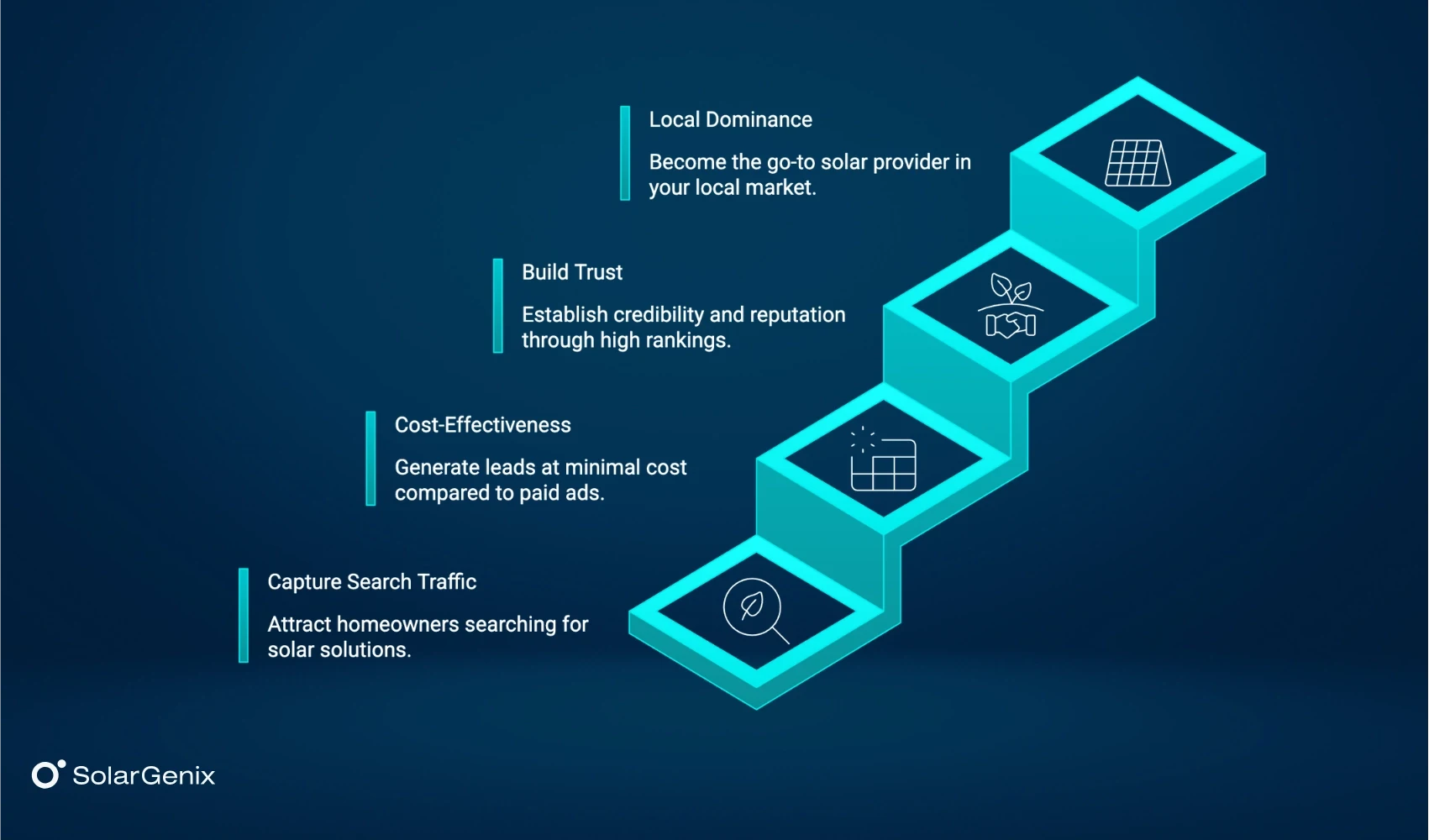
Most online experiences begin with a search engine. Homeowners who want to switch to solar type questions like “Is solar worth it?”, “How much do solar panels cost?”, or “solar installers near me” into Google.
The numbers tell the story: solar-related searches have essentially grown in the past years.
Here’s a quick overview of some of the most searched solar keywords, along with monthly search volume (US):
- Solar panels - 46K. The search intent for “solar panels” is informational, which means that the user is looking to learn more about solar panels, about how they work, what benefits they offer, and other general information.
- Solar panel cost - 22K. The search intent of this keyword is transactional. This means that the user is already looking into pricing to make a potential purchase or a financial decision regarding solar panel installation.
- Solar installation near me - 2.5K. The search intent for “solar installation near me” is local/transactional, meaning the user wants to connect with nearby solar providers to potentially buy their services.
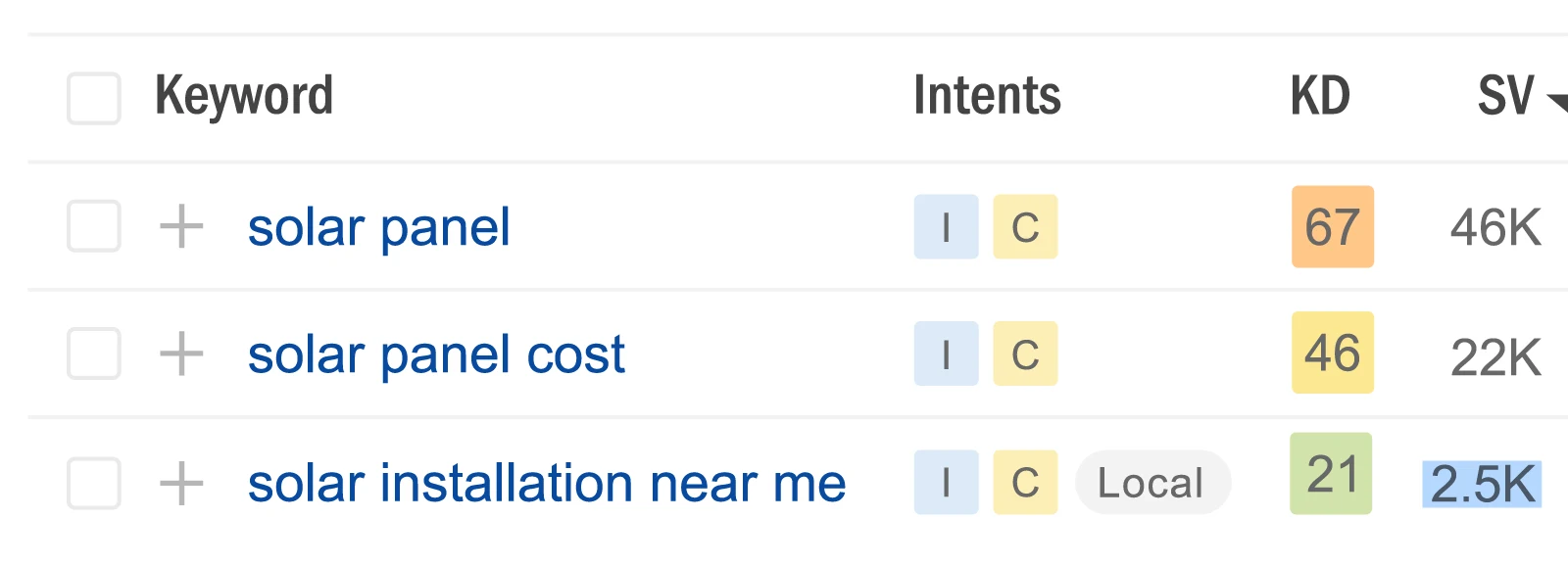
These are just a few of the dozens of keywords that can help improve SEO for solar companies. If you are able to capture even a small portion of this traffic, you’ll notice a significant increase in your lead generation.
Cost-effectiveness is another reason that makes SEO an attractive marketing investment for solar companies. Unlike paid advertising, like PPC campaigns that can cost $50-$150 per click for competitive solar keywords, organic rankings generate traffic at almost no cost.
Once your SEO efforts start working, top search rankings will bring in consistent lead flow month after month. This is why SEO is considered one of the most effective marketing channels for ROI.
It’s not just about the money, though. High search rankings also help build trust and credibility. Appearing at the top of Google search results makes any company be perceived as reputable and well-established. This is a psychological advantage over companies that might be offering services of equal quality, yet struggle with customers because of poor online presence.
And last but not least, SEO helps your business become a leader in the local market. It’s not a secret that solar works primarily locally. If you manage to dominate your local search results, you’ll get first access to high-quality, self-generated leads.
How Customers Search for Solar Products and Services on Google
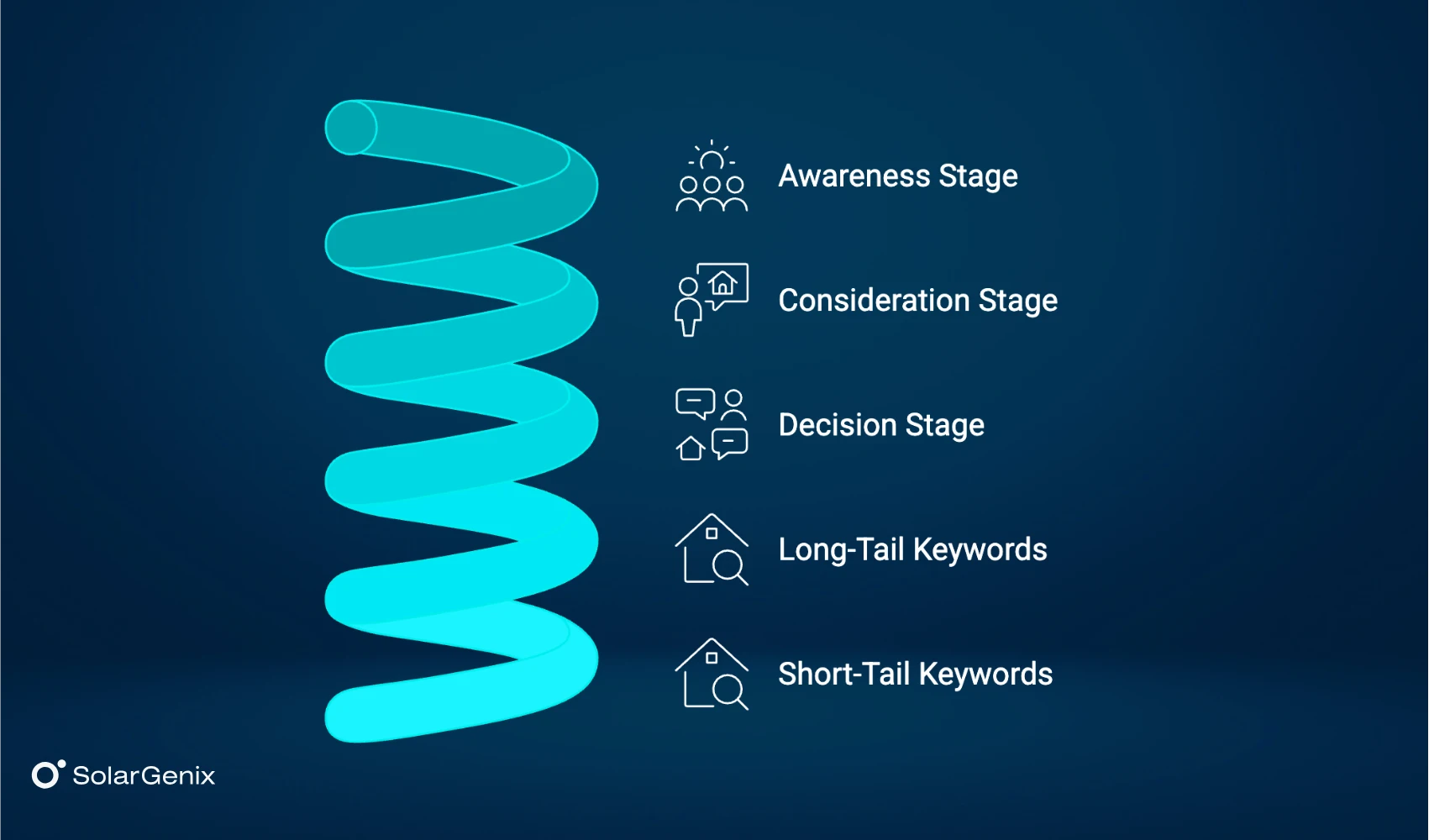
Understanding how potential customers search is at the top of our list of solar company SEO tips.
The solar customer journey usually unfolds throughout the different stages of your solar sales funnel. Each stage comes with different search behaviors and informational needs.
Awareness Stage
This is when homeowners are just beginning to explore and understand solar panel installation and solar energy in general. Their search is focused on asking fundamental questions and reading educational content.
Here are a few more examples of searches with informational intent:
- “Benefits of solar energy”
- “How do solar panels work”
- “Solar energy pros and cons”
- “Should I get solar panels”
Your goal is to educate users with comprehensive and unbiased content.
Consideration Stage
At this stage, homeowners make more specific and cost-focused searches. They are trying to understand investment requirements and compare their options:
- “Solar panel cost”
- “Solar financing options”
- “Solar incentives in [California]”
- “Solar panel payback period”
- “Best solar panels for homes”
- “Solar lease vs. buy”
In these searches, we can already notice commercial intent. This means that people are already more serious about their intentions with solar but haven’t yet chosen a provider.
Focus on delivering content that addresses their specific concerns, like solar costs or local incentives. Give detailed comparisons and guides.
Decision Stage
At this point, homeowners are ready to get in touch with providers. Their searches are already highly specific and action-oriented:
“Best solar installers near me”
“Solar company reviews [LA]”
“[Company name] reviews”
“Get solar quote”
These searches reflect transactional intent, which means users already want to communicate with you and request proposals. They are ready to act. Make sure to include keywords with transactional intent in your service pages, location pages, and other relevant landing pages.
Long-Tail vs. Short-Tail Keywords
Short-tail keywords like “solar panels” typically have high search volume but are also highly competitive and often have vague intent.
On the other hand, long-tail keywords such as “how much do solar panels cost for a 3-bedroom house in LA” or “Best solar panels for residential homes in Phoenix” have lower volume but much higher intent and are less competitive.
Homeowners who use long-tail keywords in their searches are usually further along the buying journey and better qualified.
Focus on long-tail keywords since they bring better results, but don’t completely ignore the short ones. Find the right balance.
Conduct Keyword Research for Solar Products and Services
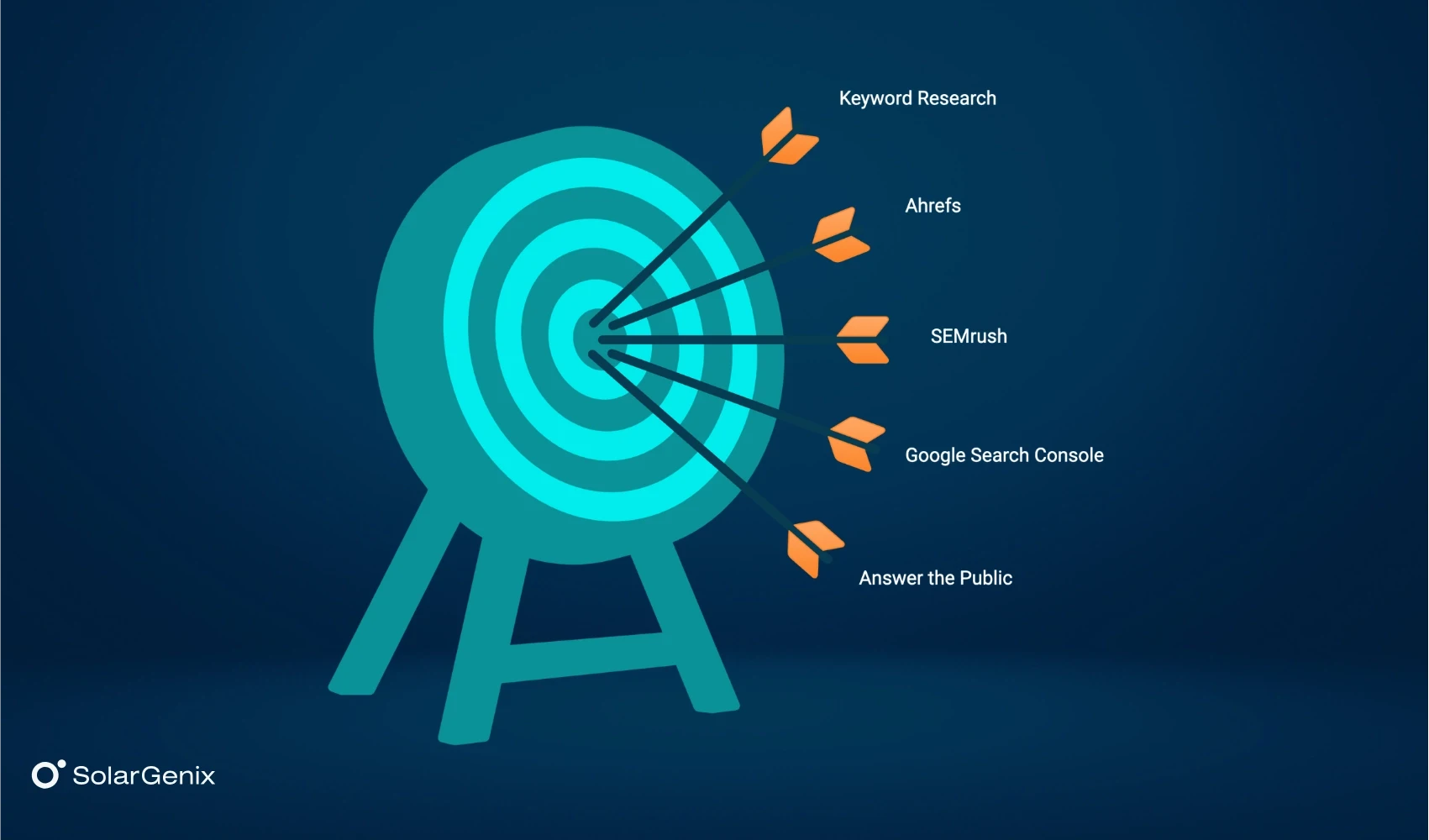
SEO for solar companies won’t get you anywhere without proper keyword research. You need to know the exact terms that your potential customers are searching for and choose the ones that will actually help you rank.
There are several tools that can help you do your keyword research in the best way possible:
- Ahrefs shows search volume, keyword difficulty, traffic potential, and ranking history. You can also use the tool to analyze the keywords your competitors are using and identify the gaps in your content.
- SEMrush comes with a comprehensive keyword research tool, like Keyword Magic, and offers competitive gap analysis. This tool will help you choose high-intent keywords, group them by topic, and not miss out on keywords that help your competitors rank.
- Google Search Console displays the keywords your site appears for in Google Search. It reveals impressions, clicks, and average position, helping you improve your existing pages.
- Answer the Public visualizes search questions, comparisons, and phrases that people ask around a certain keyword. It’s the best way to find long-tail keywords and new content ideas, especially for FAQ sections.
- People Also Ask boxes that you see in Google search results help you discover questions users want answers for. They are great sources for targeting featured snippets.
While the functionalities of some of these tools overlap and you can choose, for example, either Ahrefs or SEMrush for keyword research, we recommend that you still try to combine the use of the others to achieve the best results.
Types of Keywords You Should Target
A way to make your keyword research slightly easier is through categorization:
- Product keywords: e.g., monocrystalline solar panels, solar inverter brands.
- Service keywords: e.g., solar panel installation, solar panel maintenance, solar panel replacement.
- Location keywords: e.g., solar panels [city/state], solar company [city/state], solar installers [city/state].
- Informational keywords: e.g., how long do solar panels last, solar incentives, do solar panels work on cloudy days.
- Comparison keywords: e.g., best solar companies in [state], solar vs. traditional electricity cost, solar lease vs. solar loan.
Make sure to prioritize keywords based on search intent, search volume, keyword difficulty, and competition.
Optimize Your Solar Website Structure for SEO
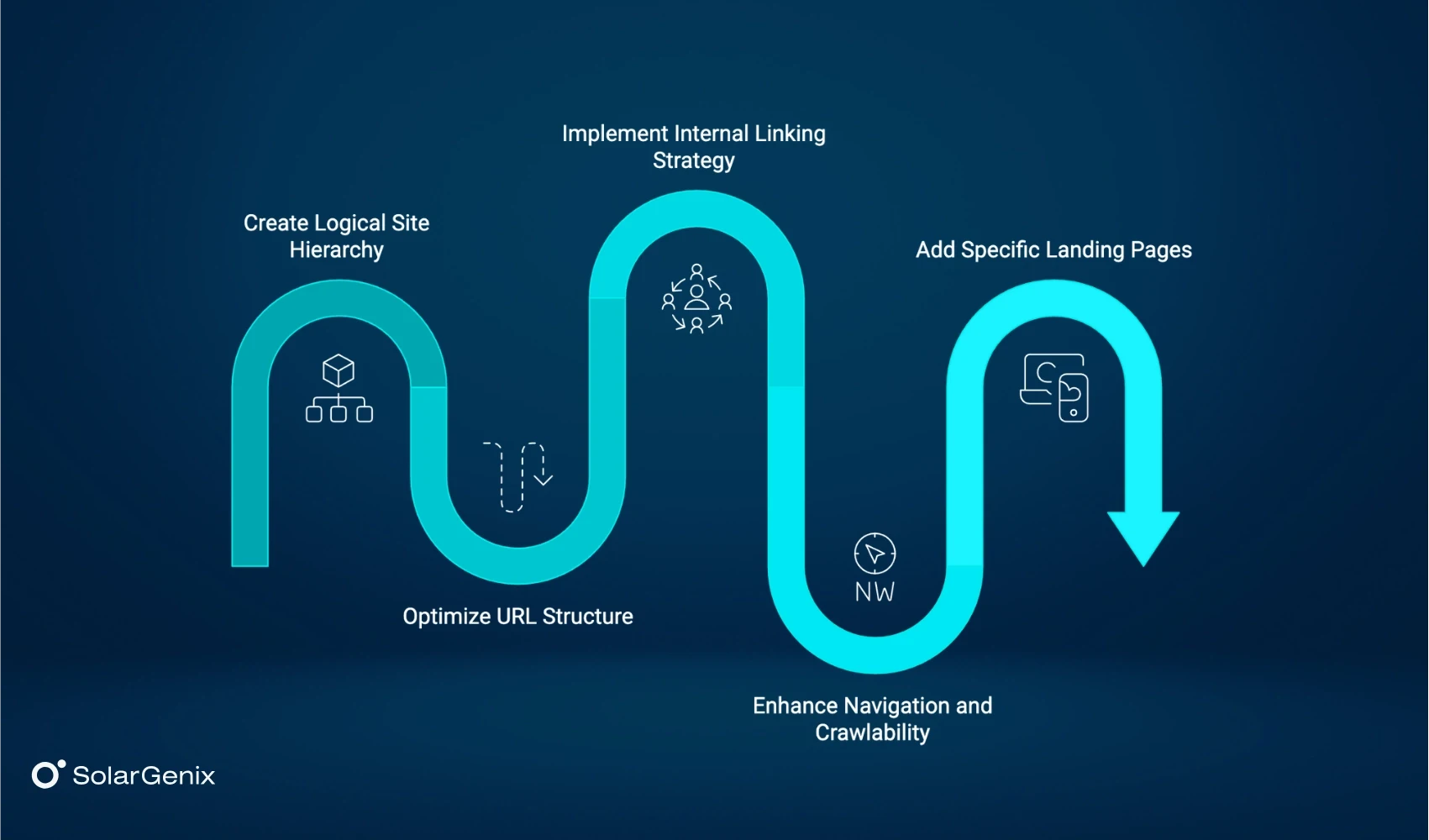
Next up in our solar company SEO tips list comes your website structure. A solid website structure is good both for users and search engines.
Create a Logical Site Hierarchy
First things first, make sure your website has a clear hierarchical flow:
Homepage→Service pages→Location pages→Blog/Resources
It’s a no-brainer that the homepage sits at the top and links to main service pages. Service pages can link to location-specific variations. Use blog posts and resources to support this structure and provide informational content.
URL Structure
Clean URLs help improve user experience and SEO.
Here’s an example of a good URL: example.com/solar-installation-austin.
Follow these tips and principles to optimize your URLs:
- Use hyphens and not underscores.
- Include target keywords.
- Keep URLs concise and legible.
- Avoid unnecessary parameters and complex strings.
- Use lowercase letters.
Internal Linking Strategy
Internal linking distributes authority across your website and sends search engines information about your content relationships.
Here are a few best practices for internal linking:
- Link from high-authority pages, like your homepage and popular blog posts, to service and location pages.
- Use a descriptive anchor text with keywords, e.g., “learn more about solar installation in San Diego.”
- Create content clusters with a pillar page covering a broad solar topic, like “Complete Guide to Solar Installation.” Support the page with different posts on subtopics and interlink them all.
Navigation and Crawlability
Clear navigation and crawlability ensure your users and search engines can easily understand and move through your website.
Navigation helps in finding pages easily, while crawlability is for search engines to discover, read, and index pages.
The main things to keep in mind about navigation and crawlability are as follows:
- Breadcrumb navigation is for users and search engines to understand page hierarchy.
- XML sitemaps provide a list of all important pages on your website. What you need to do is generate a sitemap and submit it using Google Search Console. This way, you’ll ensure that none of your content goes unnoticed by search engines.
- Robots.txt optimization guides search engine crawlers. It tells them which pages to crawl and which to leave out.
And lastly, add specific landing pages for every service area you cover:
- example.com/solar-installation-los-angeles
- example.com/solar-installation-dallas
- example.com/solar-installation-honolulu
Write unique content for each page with local incentives, average installation costs, legal information, and location-specific customer testimonials.
Master On-Page SEO for Solar Company Websites
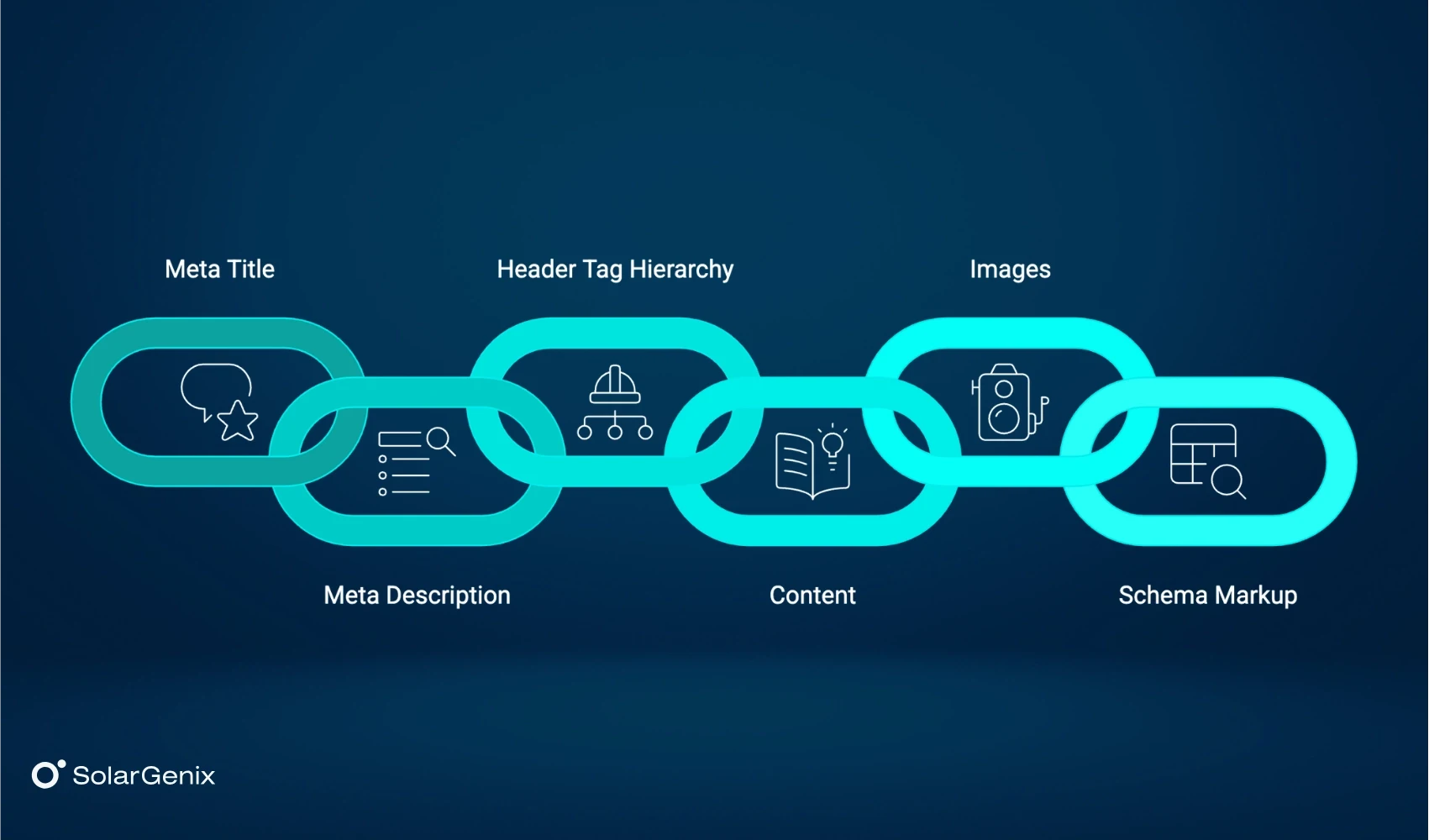
SEO for solar companies is not for the faint of heart, as you can see. The list of things you should do goes on. The next important task to focus on is on-page SEO.
On-page SEO means that you should optimize individual web pages in order to rank higher and earn more traffic.
We believe that the following tips will help you in this matter:
- Meta Title: This is the clickable headline you see in search results, which means it’s of utmost importance. Keep the title under 60 characters, include the primary keyword, and your company name at the end.
- Meta Description: Though not directly related to rankings, meta descriptions can still have an impact on your click-through rates. Keep them under 160 characters, include the primary keyword, and related terms along with a CTA.
- Header Tag Hierarchy: Use H1, H2, H3, H4-H6 tags to structure your content for better readability.
- Content: Your content should be comprehensive, optimized with primary and secondary keywords, original, valuable, and easy to scan. Use short paragraphs, don’t copy competitors, and answer user questions.
- Images: Use descriptive file names on your images, add alt text with keywords, compress the images, and use modern formats, like WebP.
- Schema Markup or Structured Data: This helps search engines understand your content and get you rich snippets in search results. From Local Business schema and service schema to review schema and FAQ schema, there are multiple types of schema that you can make good use of for your solar SEO efforts.
Do Local SEO for Solar Companies
Let’s get a slightly deeper look into local SEO for solar companies. As a solar business, the majority of your customers come from your service areas. This is why becoming visible on local search results is what can actually help with lead generation.
You can enhance your website for local SEO by following these steps:
- Optimize your Google Business Profile with your business name, address, phone, website, hours, service areas, add high-quality images, write a keyword-rich description, post updates, respond to reviews, and allow customers to directly message you.
- List your company in business directories, like Yelp, Yellow Pages, EnergySage, Solar Reviews, etc.
- As mentioned above, create location-specific landing pages and optimize the overall content of your website with locally relevant keywords.
- Do local link building. Get backlinks from locally relevant websites. Gain mentions in local news, sponsor events, teams, and NGOs, do volunteer work, partner with local builders and energy consultants, write guest posts, and try to get links from local resource pages.
Create SEO-Optimized Content That Educates Customers
Content is the backbone of SEO for solar businesses. Publish comprehensive and valuable content, and search engines will provide you with high rankings.
Content Pillars for Solar SEO
We’ve gathered a list of core topics you can use to build your content around:
- Educational guides
- Cost and savings content
- Incentive information
- Technology comparisons
- Process explanations
- Local content
Make sure to update your existing content on a regular basis to ensure accuracy and improve rankings.
E-E-A-T Principles
Follow Google’s E-E-A-T guidelines:
- Experience: Share images from real installations.
- Expertise: Write content that shows your technical knowledge and industry certifications.
- Authoritativeness: Get links and mentions from reliable and authoritative industry sources.
- Trustworthiness: Showcase your credentials, insurance, and warranties.
Target Featured Snippets and "People Also Ask" Results
Featured snippets are what you see at the top of your search results, above position #1. If you get to capture these snippets, it will essentially improve your visibility and click-through rates.
There are several types of featured snippets:
- Paragraph snippets - 40-60-word answers
- List snippets - numbered or bulleted lists
- Table snippets - comparison data
- Video snippets - embedded YouTube videos
Here are a few ways you can enhance your content to appear in featured snippets:
- Answer questions directly. Keep the 40-60 word count. Write clear, formatted answers.
- Use question headers (H2/H3).
- Use numbered or bulleted lists.
- Create comparison tables.
Use the “People Also Ask” box to see the questions people ask. Create FAQ sections and answer these questions.
FAQ sections typically target featured snippets. Use headers for each question, keep the answers short and relevant, and include FAQ schema markup.
Improve Technical SEO for Better Solar Website Performance
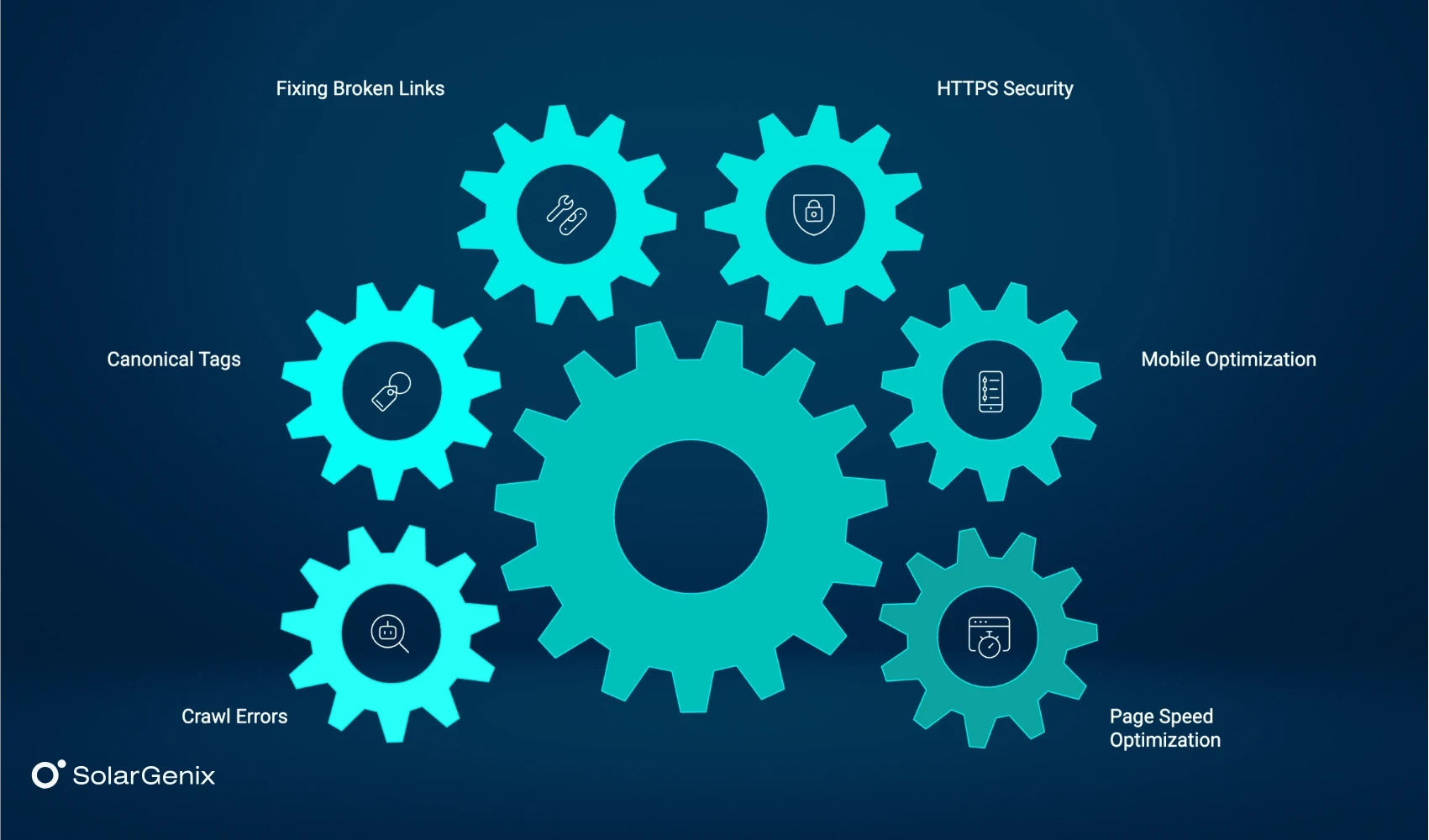
“No website can stand without a strong backbone. And that backbone is technical SEO.” - Neil Patel
No matter how good your content is, it won’t rank if you don’t carry out proper technical SEO. The latter ensures that search engines can crawl, index, and rank your website without any obstacles.
Page Speed Optimization
Pages that take ages to load frustrate users and lead to higher bounce rates. This is a sign of poor quality for search engines.
Core Web Vitals are Google’s set of metrics that measure how good a page is for real users, focusing on speed, responsiveness, and stability.
Here are the Core Web Vitals:
- Largest Contentful Paint (LCP): How fast the main content shows up. Aim for 2.5 seconds or less.
- First Input Delay (FID) / Interaction to Next Paint (INP): How quickly the page reacts to user interactions. Should be under 100ms for FID and under 200ms for INP.
- Cumulative Layout Shift (CLS): Visual stability as your page loads. Should be under 0.1.
There are a handful of things you can do to meet these metrics:
- Compress images
- Remove unused code
- Allow browser caching
- Implement a Content Delivery Network (CDN)
- Use lazy loading, i.e., loading files and images only when they are in direct viewpoint
- Minimize server response time
Use Google PageSpeed Insights to test performance.
Mobile Optimization
Google’s indexing is mobile-first, which means that it mainly uses the mobile version of your website for ranking.
Optimizing your website for mobile should be a non-negotiable:
- Implement responsive design
- Improve mobile page loading speed
- Have touch-friendly buttons that are of the proper size for finger taps
- Make text legible with a minimum of 16px font size
- Don’t have frustrating popups that cover the main content
HTTPS Security
HTTPS is another important ranking factor. If your website lacks it, it will be marked “Not Secure” in browsers. This can significantly damage trust and conversions.
Install an SSL certificate and redirect all your HTTP pages to HTTPS versions.
Fixing Broken Links
Broken links or 404 errors signal poor user experience. Such tools as Screaming Frog and Ahrefs can help you identify broken internal and external links. Afterwards, you can use these tools to:
- Fix or redirect broken internal links
- Update or completely remove the external ones
- Create custom 404 pages that will guide users back to other content
Canonical Tags to Prevent Duplicate Content
Canonical tags help search engines choose the version of similar or duplicate content that will be indexed. This way, you avoid duplicate content penalties.
Here’s when you should use canonical tags:
- Multiple URLs that contain the same content
- Location pages that have a similar structure
- Product pages with variations
- HTTP and HTTPS versions that are both active
Fixing Crawl Errors in Google Search Console
Google Search Console detects crawl errors, security issues, and indexing problems.
Make sure to check the following every now and then:
- Coverage report that shows indexing errors.
- URL Inspection tool to see if specific URLs are indexed.
- Sitemaps
- Mobile usability
Address all errors immediately.
Build High-Quality Backlinks to Your Solar Website
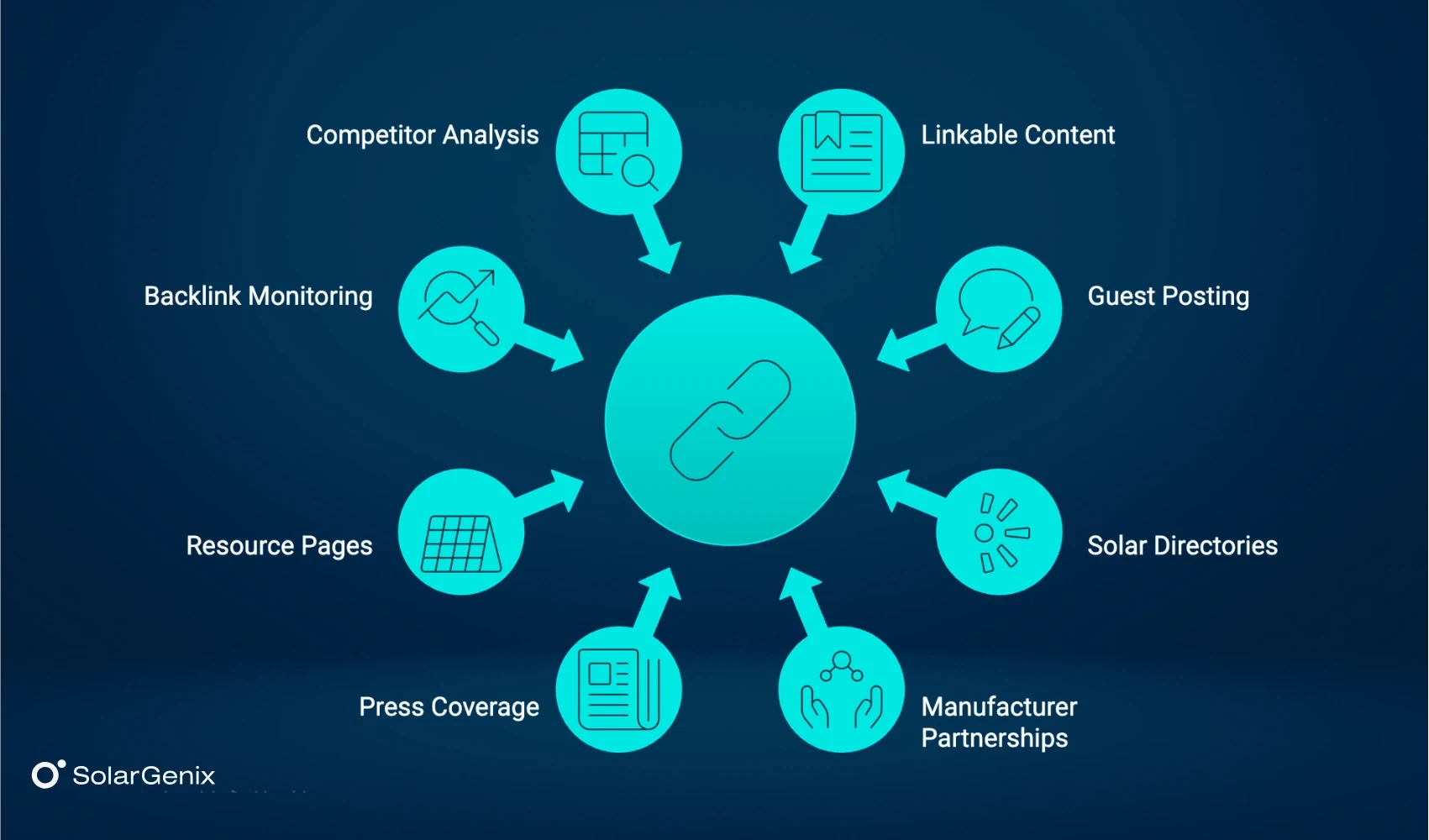
As we move further down the list of solar company SEO tips, backlinks appear in the view.
It’s not that they are less important. On the contrary, search engines view them as a sign of authority, trustworthiness, and relevance.
The best strategies for getting backlinks are as follows:
- Publish linkable solar content, from comprehensive guides to infographics and interactive content.
- Write guest posts on sustainability blogs, home improvement websites, or energy efficiency publications.
- Get listed in solar directories (EnergySage, NABCEP installer listings, etc.).
- Partner with solar manufacturers and suppliers.
- Get press coverage for newsworthy events at your company.
- Find resource pages and offer your content as an addition.
- Monitor your backlink profile via Ahrefs or SEMrush.
- Analyze competitor backlinks for more opportunities.
Optimize for AI Search and Solar-Related Queries
AI search focuses on longer, more conversational queries. Instead of “solar cost LA”, people ask “Is solar worth it in LA, considering my $250 monthly energy bill?” A question like this requires a direct answer.
If you want to create content for AI search, here are a few things you should focus on:
- Use natural and conversational language.
- Target long-tail and question-based keywords.
- Use answer-first format. Give direct answers immediately, then elaborate.
- Include city/state-specific solar information, such as incentives, energy rates, etc.
- Write multiple, well-connected content pieces about all things solar to position yourself as a solar expert.
Leverage Video Content for Solar SEO
Video content is one of the most impactful tools in digital marketing. Google is the owner of YouTube, which is pretty much the second-largest search engine on the planet. This means that video content is preferred by many users - it is engaging and keeps people on your website longer.
To create SEO-optimized solar videos, you need to:
- Embed videos on your website, adding them to landing pages so that users stay with you as long as possible.
- Create video sitemaps for search engines to understand your video content. This way, you’ll increase the possibility of appearing in video search results.
- Add video schema markup to allow search engines to display rich snippets in search results.
Create videos that are relevant, interactive, and of high quality.
Monitor Your Solar SEO Performance with Analytics
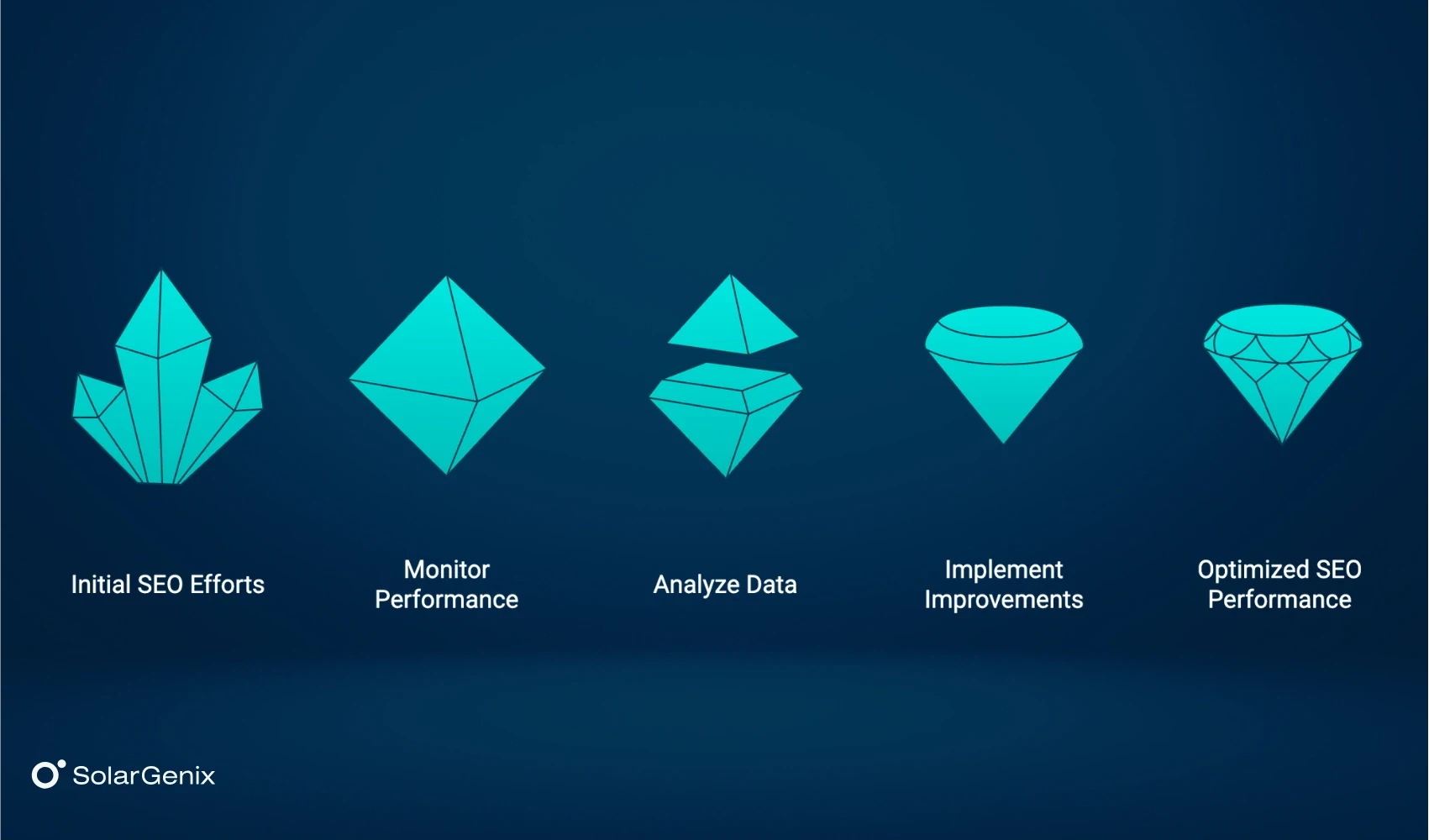
SEO for solar companies requires consistent tracking. Only through tracking can you understand what’s working, find more opportunities for improvement, and measure ROI.
Use Google Analytics 4 to:
- Monitor organic traffic and see which pages attract visitors.
- Track engagement metrics, such as average session duration.
- Use conversion events (form submissions, requests for quotes) to link traffic to lead generation.
Use Google Search Console to:
- Track keyword rankings and click-through rates for the highest-performing pages.
- Check index coverage and make sure all your pages are discoverable.
- Detect crawl errors and other problems messing with your SEO performance.
Know your SEO metrics:
- Organic sessions and new users
- Keyword rankings
- Conversion rates from organic traffic
- Bounce rates and time spent on page
Use Ahrefs, SEMrush, and other third-party SEO tools to:
- Check backlink quality and growth
- Do competitor comparisons and look up domain authority changes
- Find keyword opportunities
Performance monitoring is the only way to see if your SEO efforts are bringing tangible results and what you can do to make things better for your solar website.
Optimize Your Solar Website for Lead Conversion
Ranking on page one on Google is half the battle. If your website has thousands of monthly visitors but the conversion rate is less than 2%, you’re doing something wrong.
Poor conversion rates are a sign that your website does not meet user intent, which can have a negative impact on your rankings as well.
Conversion Rate Optimization for Solar Sites
If you want to convert visitors into actual leads, you need to understand their journey and remove friction and obstacles every step of the way.
Here’s what we recommend that you do to improve conversion rates:
- Use heat maps, like Hotjar or Microsoft Clarity, to monitor how visitors interact with your website. These tools provide visual representations that show you where users click, how far they scroll, and what sections they ignore. Heat mapping can help you find bottlenecks, such as scroll depth issues, distraction zones, and mobile behavior in comparison with desktop behavior.
- Implement exit-intent popups to capture leads before visitors leave your website. Offer free consultations or guides. Do A/B testing to choose the version that works best.
- Set up a retargeting pixel. Track visitors and show follow-up ads to re-engage those who didn’t convert during their first visit.
Integrate SEO with Your Overall Solar Marketing Strategy
On we go with our solar company SEO tips. The next important step is to integrate SEO with your overall marketing strategy to strengthen its impact and further improve your brand presence.
Coordinate your SEO strategy with all the other marketing channels:
- Content marketing: write SEO-optimized educational blog articles.
- Social media: Increase engagement and brand signals by sharing SEO-based posts.
- Email marketing: Promote new content and link back to your website.
- Paid search: Gather data from your PPC campaigns to find high-converting keywords.
- Offline marketing: Flyers, door-to-door sales, and relevant local events are a good opportunity to make people search for your brand name online.
Use SEO insights to improve and inform your marketing strategy. Make sure to have a unified and consistent brand message across all your channels. Target better and personalize your messages by using customer data.
Use Solar Proposal Software to Accelerate the SEO-to-Sale Process
SEO brings you leads, but doesn’t close deals. Using solar proposal software, you can shorten the time between a visitor’s initial interest and a signed contract.
Let’s see how proposal software, like SolarGenix, can help you achieve closed deals:
- Instantly generates professional proposals as soon as you get website inquiries.
- Shortens the time between inquiry and quote.
- Offers accurate ROI calculations - exactly what homeowners expect.
Check out the features that support SEO-driven leads:
- Branded proposals that align with your website messaging.
- Fast turnaround while your leads are still warm and engaged.
- Savings calculations built on your educational content. You can use SolarGenix Lead Capture software to provide visitors with monthly and 25-year savings data, annual energy production estimates, and panel placement recommendations in exchange for their contact information and monthly electricity bill amount.
- Integration with website forms and CRMs.
Common Solar SEO Mistakes to Avoid
SEO for solar companies is quite a challenging and complex process, and it’s absolutely natural to make mistakes along the way.
We have made a quick list of the most common mistakes that solar companies make on their SEO journey. Check them out in order to be able to bypass them:
- Targeting only high-volume keywords and ignoring long-tail, high-intent terms
- Neglecting local SEO and missing the most qualified leads for solar
- Creating thin or duplicate content across location pages
- Keyword stuffing and over-optimization
- Not creating enough content regularly
- Ignoring user experience and filling your site with confusing navigation or poor design
- Copying competitor content
- Having inconsistent NAP information across the web
- Ignoring negative reviews