Time and again, the same pattern repeats: social media marketing proves to be anything but simple for solar providers. In order for homeowners to come to a final decision, solar marketers need to guide them through a lengthy and complex buying journey, which requires way more than a single post or ad.
Social media marketing for solar companies requires a strategic approach; one that is often accompanied by additional supporting tools, such as solar design software to help visually explain system layouts, energy production, and savings.
In this guide, we’ll help you learn how to choose the right platforms, create educational content, generate qualified leads, and track performance to make the most of your social media marketing efforts.
Key Takeaways
- Social media supports the lengthy solar sales cycle by educating and nurturing homeowners.
- It’s better to choose the right social media platforms for your company than be everywhere.
- Educational and visual content help build trust, engagement, and possible conversions.
- Consistency matters more than anything in social media marketing for solar companies.
- Paid ads are as important as organic content.
- Integrating social media with sales tools and solar proposal software helps speed up the process from initial interest to installation.
Why Do Solar Brands Need to Invest in Social Media Marketing?
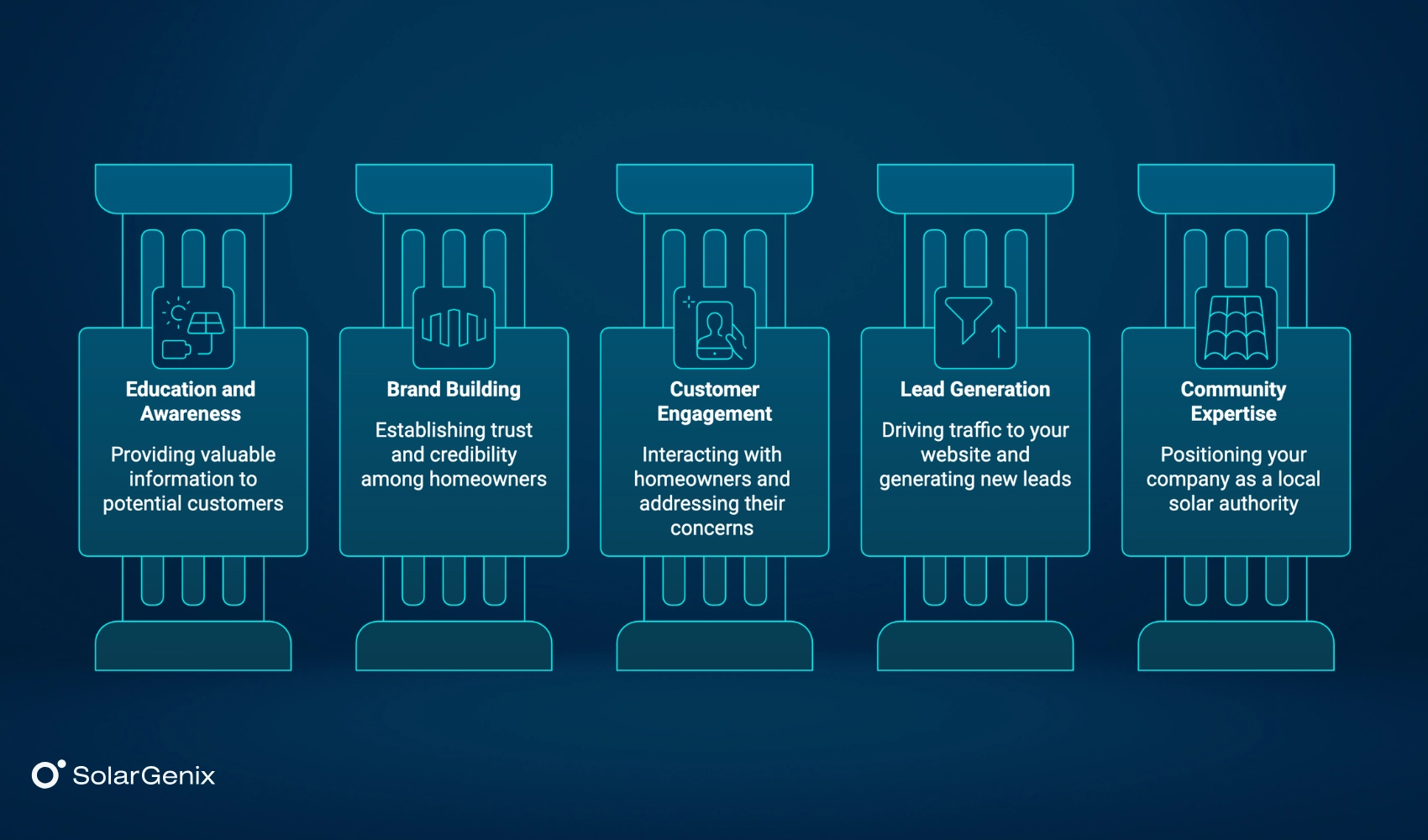
Solar social media marketing is important because people don’t buy solar panels impulsively. They need to be nurtured, educated, and reassured before committing.
Social media helps you:
- Educate your prospects at the top of your solar sales funnel.
- Answer common questions before the sales conversations start.
- Build your brand awareness as well as familiarity and trust.
Today, homeowners do their research online. They watch videos, read reviews, and compare installers. Social media enhances your online presence, making your company credible, reinforcing your email marketing campaigns, paid ads, and increasing your website traffic. It helps you meet homeowners where they already are - researching and evaluating their options.
According to research, 1 in 3 homeowners report a 25%+ increase in their home improvement spending after seeing content on social media. Millennials and Gen Z-ers are more influenced by social media posts than the older generation.
Studies show that social media impacts attitudes, intentions, and even behaviors toward renewable energy. Instagram users believe that social media is helpful for learning and information sharing.
It’s one of the many touchpoints for solar: it often serves as the crucial first impression that determines the further steps of your prospects.
And finally, social media helps you become the neighborhood solar expert through consistent sharing of local installation projects, participating in community events, and showing your knowledge of local utility rates.
Choose the Right Social Media Platforms for Your Solar Business
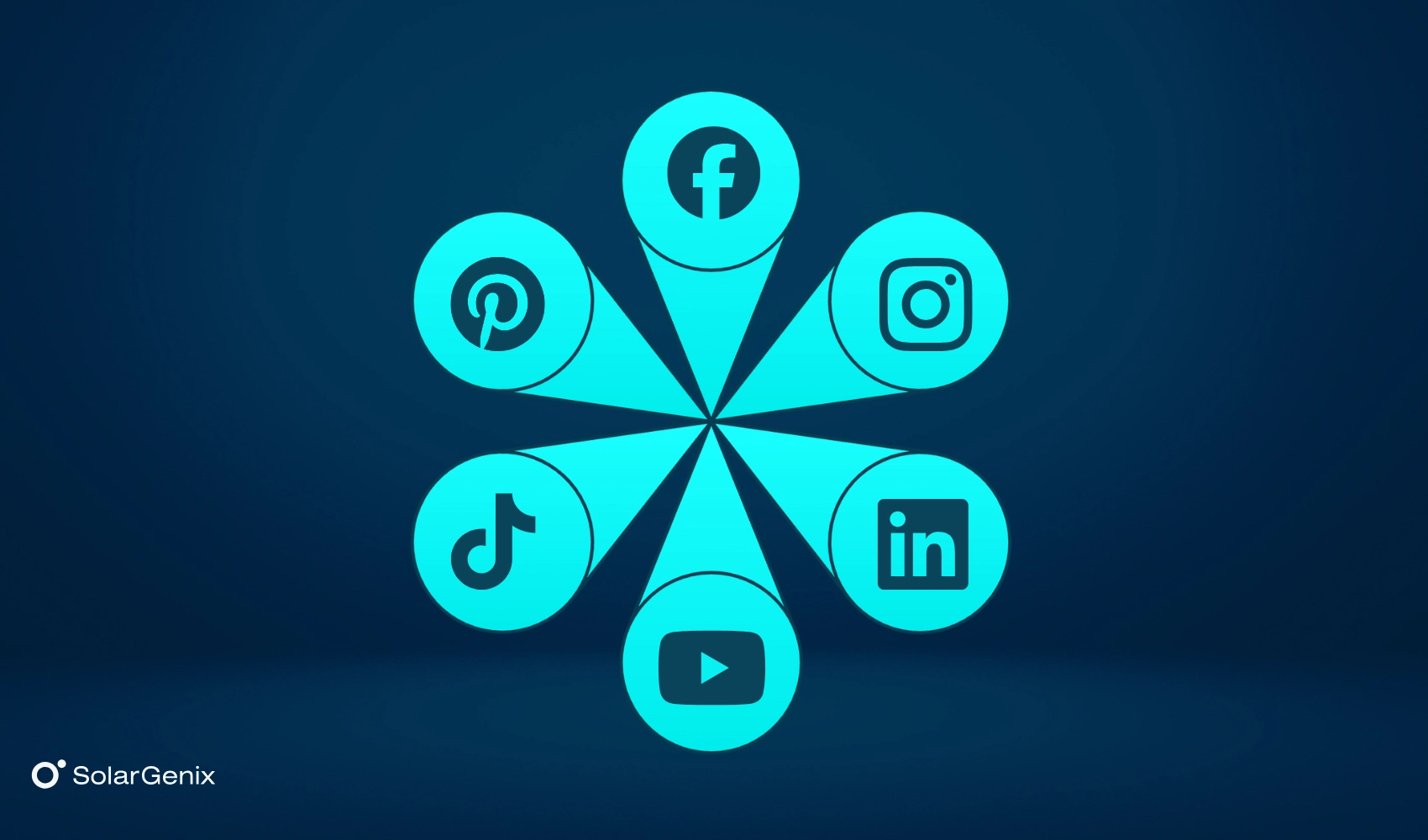
Social media platforms come in all shapes and sizes, and each requires a unique approach. You don’t have to distribute your attention equally to all of them. Just find the right balance based on your target audience, resources, and business model.
Let’s have a quick overview of the main platforms:
- Facebook remains the dominant platform for social media marketing for solar companies, especially those targeting homeowners aged 35-65. It has comprehensive local targeting functionalities and helps you reach homeowners within your specific service areas. You can also use Facebook for community building by creating business pages, groups, and engaging in local discussions.
- Instagram is the go-to social channel for visual storytelling using before-and-after installation images, short videos, and testimonials. It’s more popular among younger homeowners.
- LinkedIn serves a slightly different purpose for solar providers, more focused on B2B relationships, commercial solar projects, and industry thought leadership. You can also use the platform to build partnerships with electricians, roofers, real estate agents, and other specialists who can refer residential customers.
- YouTube is mainly for long-form education content. It offers both immediate engagement and long-term search traffic. Provide value by posting videos about how solar works, installation walkthroughs, financing breakdowns, and customer stories. YouTube is integrated with Google search, which means your videos will appear in search results on Google as well.
- TikTok is the place where you can target younger homeowners, particularly first-time home buyers in their late twenties and early thirties. You can use the platform to share short tips, debunk solar myths, show behind-the-scenes installation moments, and be in tune with what’s trending.
- Pinterest stands out from the bunch as it functions differently. It’s a visual search engine for home improvement inspiration. You can create pins with beautiful solar installations, solar design ideas, and link to detailed guides on your website. Pinterest content can keep generating impressions and clicks for years after the initial publication.
Define Your Solar Social Media Marketing Goals
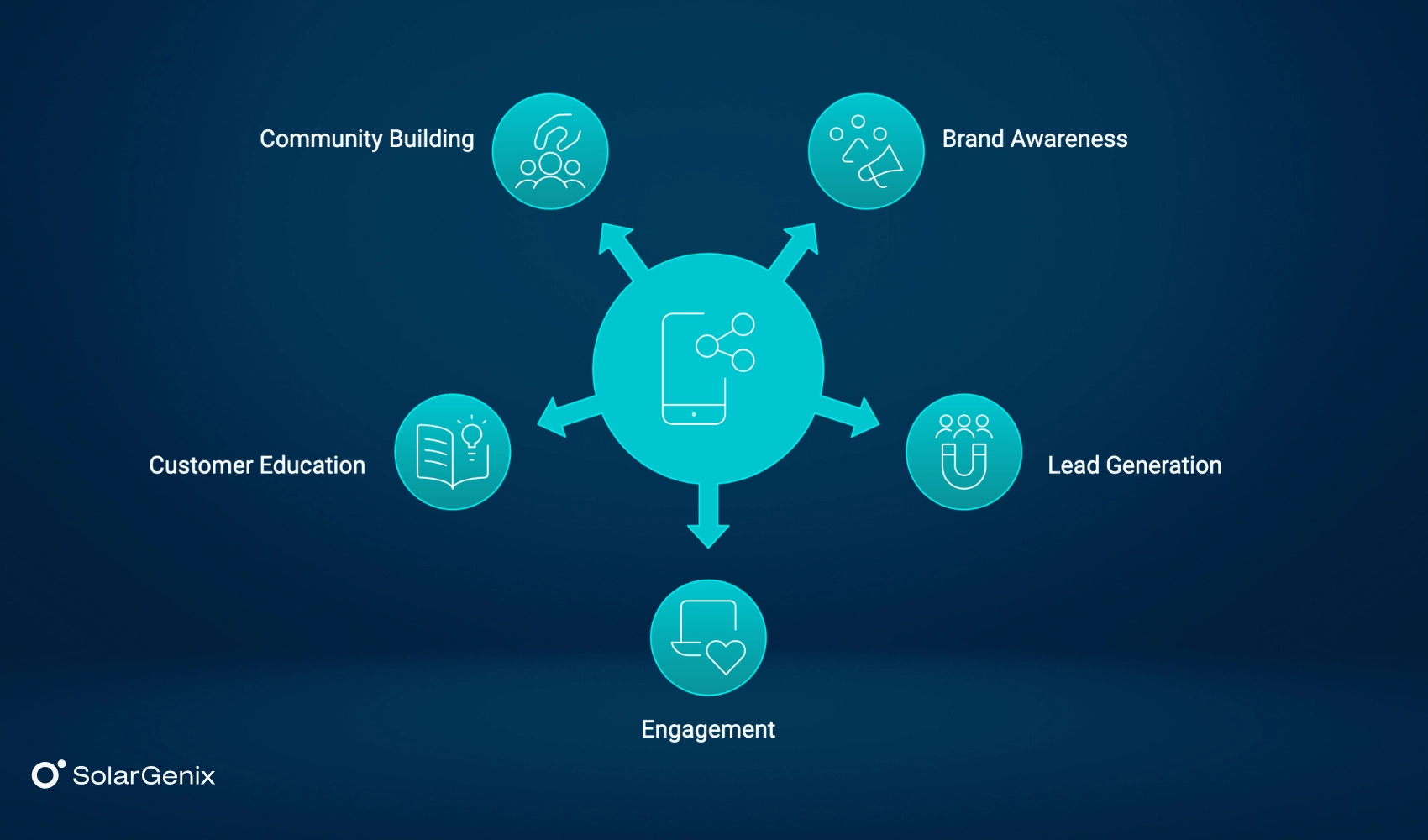
Effective social media marketing for solar companies requires clearly defined goals that are in line with your business objectives. Set SMART goals - Specific, Measurable, Achievable, Relevant, and Time-Bound - to create accountability and be able to track progress and tangible outcomes.
The most common goals include:
- Brand awareness, which entails focusing on growing your reach and visibility. The metrics you should keep an eye on are reach, impressions, and follower growth across platforms.
- Lead generation goals will help you measure actions that have purchase intent. Track form submissions, quote requests, consultation bookings, and downloads of lead magnets (e.g., solar savings calculators). Users carry out these actions by clicking on social media links, sending direct messages, or using Facebook appointments.
- Engagement shows how actively your target audience interacts with your content through likes, comments, shares, saves, and other platform-specific reactions.
- Customer education: Most homeowners need lots of information before they’re even ready to request a quote. Measure your success in customer education by checking video view counts, content download numbers, guide shares, and time spent on linked content.
- Community building measures the strength of relationships with your customers and prospects. Group participation in Facebook communities, user-generated content submissions, and repeat engagement from the same users are all proof of you being a reliable solar provider in the community.
Again, make sure to align your social media goals with your business strategy to ensure actual results and revenue growth.
Understand Your Target Audience on Social Media
Another way to successful social media marketing for solar is through understanding your target audience. Generic content won’t take you too far. Your posts need to reflect that you know exactly who you’re talking to.
We recommend that you take the steps listed below to identify your target audience:
- Create solar customer personas for social media. Define distinct segments of your target audience based on their specific characteristics, needs, and preferences.
- Use demographic factors, such as age, income, location, and homeownership status, to establish the profile of your ideal solar customers.
- Understand the psychographics (environmental values, cost concerns, energy independence) to reveal the motivations and pain points that stand behind purchase decisions. Eco-conscious buyers, for example, are concerned about reducing their carbon footprint. Practical homeowners care about cost savings and reducing their expenses.
- Analyze behavioral patterns such as active hours, preferred content formats, and research habits. These details will help you decide when and how to engage with your audience on social media for maximum visibility. The majority of people are most active online early mornings before work, lunch breaks, and evenings after dinner.
- Analyze competitor audiences to gain valuable insights into market positioning and opportunities that you weren’t aware existed. Check out the posts that generate the highest engagement on competitor pages, what questions people ask in their comments, which content formats they prefer, and how their audience responds. Look for gaps in their content strategy to provide better information or serve underrepresented audience segments.
Create a Content Strategy That Educates and Converts
Follow the 80/20 rule when building your solar social media marketing content strategy. This rule encourages solar marketers to dedicate 80% of their content to educational and entertaining material that delivers value, with only 20% focused on directly selling solar panels.
Homeowners for residential solar are often skeptical of direct and aggressive sales pitches - don’t frustrate them more.
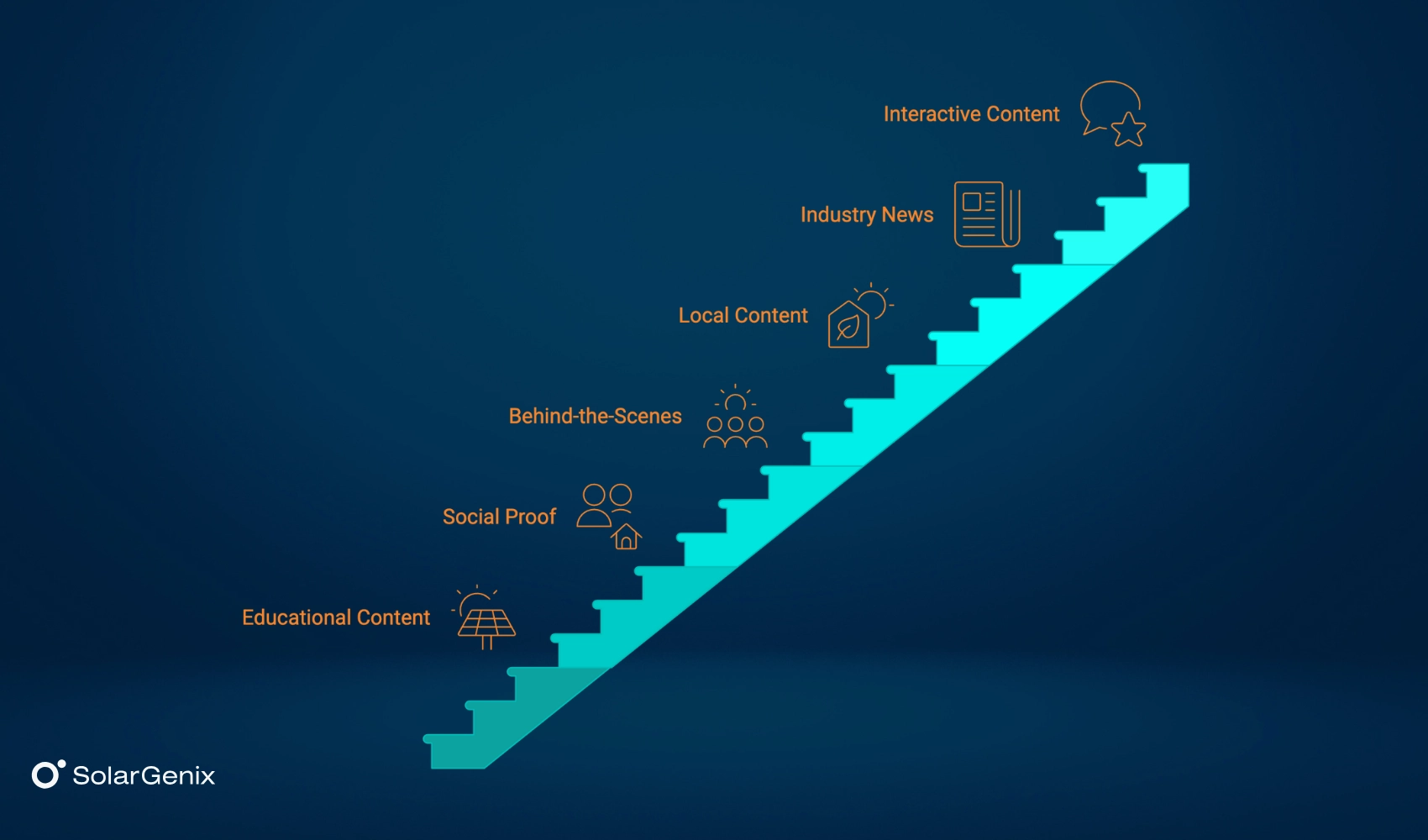
Here are the main content pillars you should focus on:
- Educational: This type of content is the foundation of social media marketing for solar because it addresses the knowledge gaps that prevent homeowners from committing. Cover everything, from how solar works to financing options, available incentives, ROI, etc.
- Social Proof: Share video testimonials, case studies, and before-and-after installation images to build credibility with your prospects.
- Behind-the-Scenes: Humanize your content by showing the installation process and your team culture. This way, you’ll make your company look accessible and reliable.
- Local Content: Further prove your credibility by showing local installation projects, recognizable neighborhoods, and familiar home styles.
- Industry News: Let people know about policy changes that affect solar incentives, installation requirements, or net metering rules. Provide clear and simple explanations.
- Interactive Content: Organize polls, Q&As, and live sessions to improve engagement and algorithm performance while providing homeowners with hands-on solar insights.
Additionally, be mindful of your choice of content formats. Here are the ones that we believe work best for solar social media marketing:
- Static posts with carousel images. Use this format to share step-by-step explanations, multiple customer testimonials, or before-and-after comparisons.
- Short-form videos, such as reels, stories, and TikToks.
- Long-form educational videos.
Develop Engaging Visual Content That Showcases Solar Installations
A minor objection many homeowners often have is that solar panels will look ugly on their roofs. You can use social media to handle this objection in advance by posting high-quality visual content. This will help them picture the result of solar installation clearly and possibly want to learn more about what it would look like on their roofs.
There are different types of visual content you can use. The most effective ones for social media are:
- Before-and-after installation photos
- Drone footage of solar arrays
- Time-lapse installation videos
- Customer home tours with system explanations
- Infographics showing long-term savings
- Team photos and behind-the-scenes moments
Visual content not only shows that solar panels can actually look quite aesthetic on roofs. Its main goal is to explain how the whole system works and what the installation process is like, combining education with entertainment.
As they say, it’s better to see something once than to hear about it a thousand times.
Build an Engaged Community Around Your Solar Brand
Engagement is, by far, the biggest sign that social media marketing for solar companies is actually doing its job. It matters more than follower count.
Having a smaller, active audience converts much more quickly than a large, yet passive one.
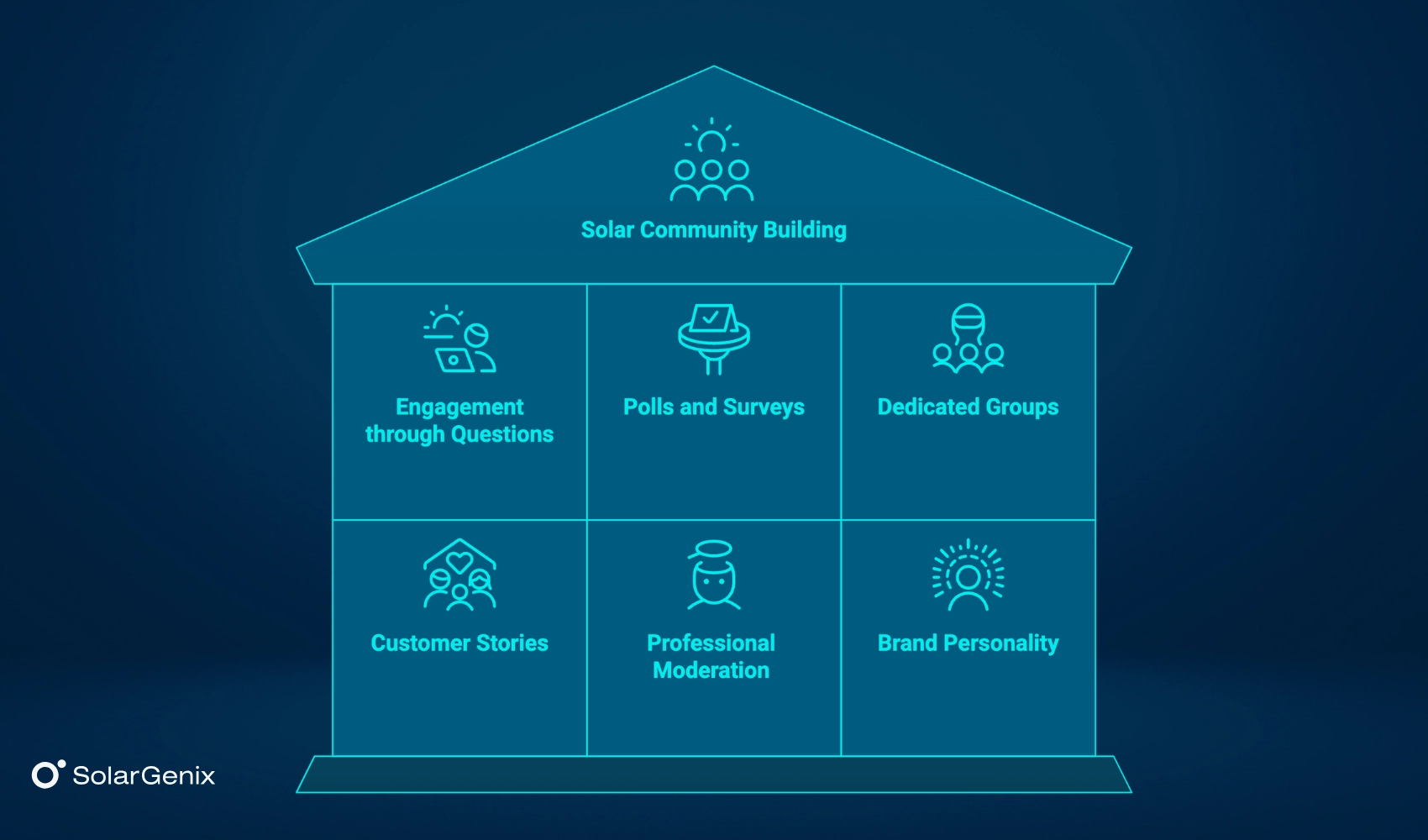
We have a few tips for you to help build a stronger community of homeowners around your brand:
- Ask questions in captions to give your followers an opportunity to engage with your posts naturally. E.g., you can ask questions like: “What’s your biggest concern about going solar?” or “How much is your current electricity bill?”
- Carry out polls and surveys. This way, you’ll use the platform features while simultaneously engaging people and gathering important information.
- Create Facebook and LinkedIn groups specifically for solar customers and prospects and build dedicated community spaces. This will allow existing customers to share their experience, answer questions, and support each other. There’s no pressure of direct sales, but there’s potential for referrals. The latter are one of the best sources for qualified solar leads.
- Feature customer stories and spotlights to celebrate your customers who have successfully switched to solar while providing social proof and motivating others to share their experiences as well. If possible, do this regularly - create monthly or weekly spotlights and describe the solar journeys of satisfied customers.
- Moderate active conversations professionally to ensure a positive atmosphere in the community and safeguard your reputation. Always respond to comments and questions, even if the commenter isn’t a potential customer. Don’t dismiss homeowners’ concerns.
- And finally, build a brand personality that is based on trust and emotional connection. Be consistent with your brand voice and show your brand personality in every piece of social media content you create and in every interaction.
Follow these steps to build an authentic brand and a solar community that trusts your brand.
Optimize Your Social Media Profiles for Lead Generation
When prospects find your company through ads, content, or referrals, they should be able to immediately understand what you offer and how to move forward.
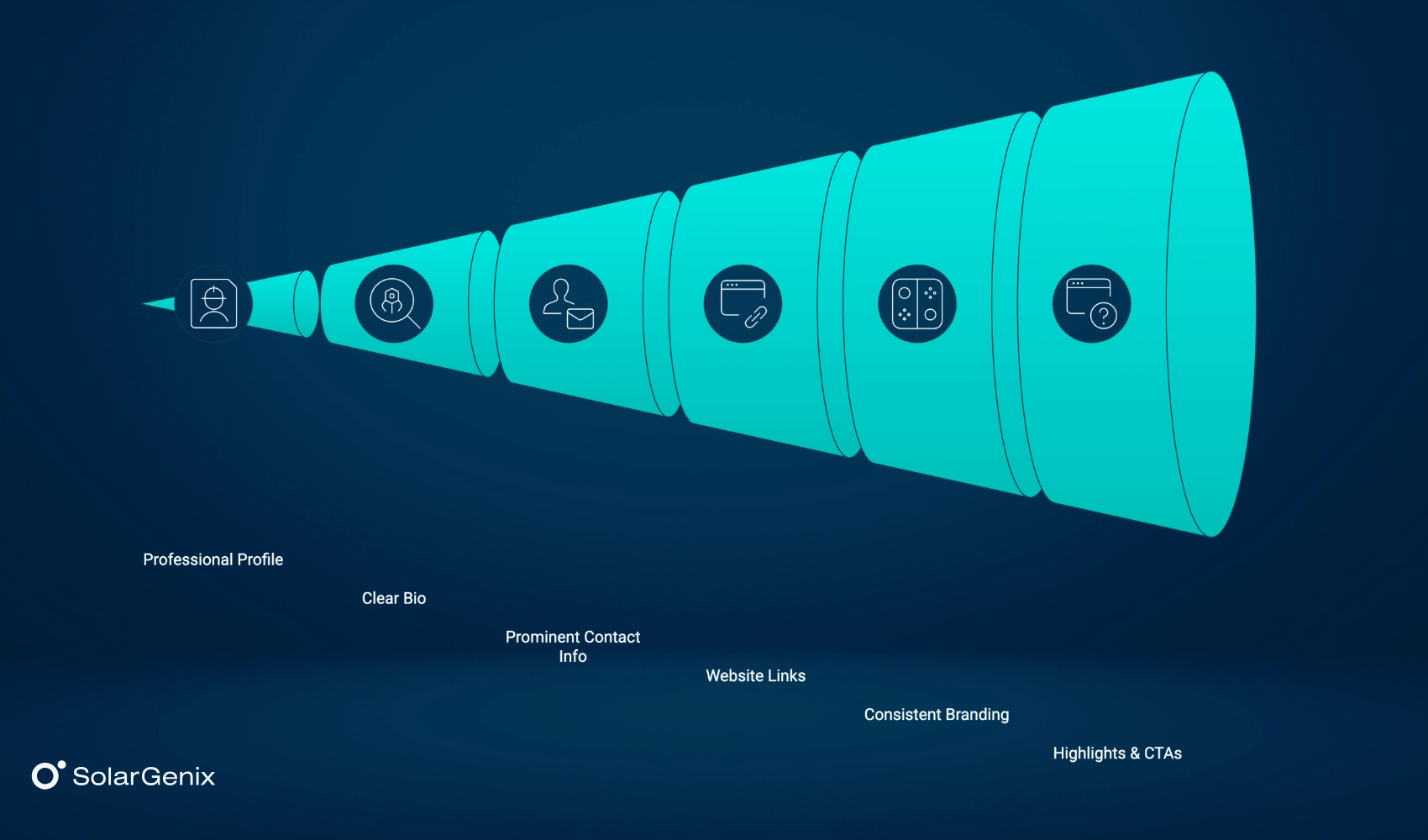
Here’s a social media profile optimization checklist to make things easier for you:
- Create a professional, high-quality profile with pictures that reflect your brand identity. Use your logo or company mark as your profile photo and your best installation case as your cover photo. The latter can also be your team in action or happy customers. Update cover photos seasonally, or whenever you have promotions.
- Write a clear bio that explains what you do and who you serve. Mention your value proposition, service area, and what makes you unique. Include keywords.
- Display contact information prominently - phone numbers, email addresses, and physical addresses. Enable messaging and include accurate business hours.
- Include links to your website or dedicated landing pages. Update them based on ongoing campaigns.
- Keep your branding consistent across all platforms. Use the same logo, color scheme, tone, and messaging.
- Use highlights and featured content to keep your best work and important information at the top of your social media accounts. On Instagram, you can have such highlights as “FAQ”, “Testimonials”, “Installations”, and “Savings” for easy access. Facebook allows you to pin posts, while LinkedIn offers featured posts, articles, and media.
- Include strong CTAs, e,g., “Get Your Free Quote”, “Schedule a Consultation”, or “Calculate Your Savings.”
- Use Facebook lead forms to collect data without requiring users to leave the platform. Also, don’t miss out on Instagram action buttons for direct calling, emailing, or booking.
- Create platform-specific landing pages that match your social media campaigns and promotions. For example, you can include a link to your lead capture tool and get your prospects’ contact info while providing them with valuable information on solar panel placement, savings, energy production, and more.
Make sure to remove every possible obstacle and make it effortless for your prospects to take the next step. Optimize for mobile because people rarely use their laptops to scroll through their social media feeds. Test your contact process every now and then to ensure there are no broken links and confusing steps.
Turn Social Media Followers Into Solar Leads
Don’t expect your followers to convert into qualified leads overnight. Not all of them are ready to request a quote but, mind you; a lot of them are willing to take intermediate steps. This can be a good place to start relationship building and slowly move them down your sales funnel.
Here are some key tactics to help you turn your social media followers into solar leads:
- Create lead magnets, such as solar savings calculators, incentive guides, and ROI worksheets, in exchange for important information (contact details, monthly electricity spending, or roof details).
- Run social media ads focused on lead generation, using platform-specific features that are designed to capture contact information. Facebook and Instagram offer lead ads that come with pre-filled forms, making submission extremely easy.
- Offer limited-time promotions to social media followers exclusively.
- Include clear CTAs in every post.
- Use link-in-bio tools, such as Linktree, Later, or Stan Store. Include only the important links, such as savings calculators, testimonials, or quote requests.
- Retarget engaged users by showing them case studies, video testimonials, or special offers.
- Nurture leads with follow-up sequences to continue educating them on solar and building trust.
Use Paid Social Media Advertising to Reach More Homeowners
Solar social media marketing works best when you combine organic content with paid ads. The former is important for community building and engagement, while the latter is necessary to reach more homeowners in your target area.
Best Social Media Platforms for Paid Ads
Facebook and Instagram Ads offer detailed targeting parameters, allowing you to reach homeowners based on age, income level, interests, behaviors, and geographic location. As already mentioned, they also offer lead form ads, which can capture contact details without asking users to leave the platform.
On top of these, there’s also the ‘lookalike audiences’ feature, which identifies new prospects who share characteristics with your current customers.
YouTube Ads have both skippable in-stream ads that play before (pre-roll videos) or during videos, and non-skippable bumper ads for short messages. Display ads appear along with video content on desktop platforms. It should be noted that such video ads are also available on Instagram and Facebook.
LinkedIn Ads are more for targeting business decision-makers for B2B solar partnerships and commercial projects.
Targeting Strategies
Here’s a breakdown of the main targeting strategies used in paid social media marketing for solar companies:
- Geographic targeting ensures your ads reach homeowners within your service area only.
- Demographic targeting helps you choose the age range, income levels, and homeowner status (if the platform offers this feature) of the people your ads will be displayed to.
- Interest targeting focuses on people who are curious about sustainability, renewable energy, home improvement, and environmentalism. You can set such interests as hiking, outdoor recreation, and relevant environmental causes.
- Behavioral targeting allows you to target new homeowners who are planning improvements and haven’t yet built a high electric bill history. Include home improvement shoppers who are researching or buying appliance upgrades, or doing things like weatherization.
Ad Formats That Work Best for Solar
Choose from one or more of the following ad formats to make the most of your paid advertising efforts:
- Solar installation video ads
- Carousel ads with multiple customer stories
- Lead generation ads with instant forms
- Retargeting ads for website visitors
The best ads are the ones that show your work, build credibility, and lead to real actions.
Budget Recommendations and Bidding Strategies
Your company size, growth goals, and market competitiveness are deciding factors for budget and bidding. However, we recommend starting with a small budget, around $500-1000 monthly per platform. This way, you can gather performance data and then scale accordingly.
Use automated bidding recommended by social media platforms initially. Once you know your cost per lead and lead quality, you can switch to manual bidding.
And finally, always track conversions and ROI and do A/B testing of creatives and copy to achieve the best results from your paid campaigns.
Leverage Local SEO and Geo-Targeting on Social Media
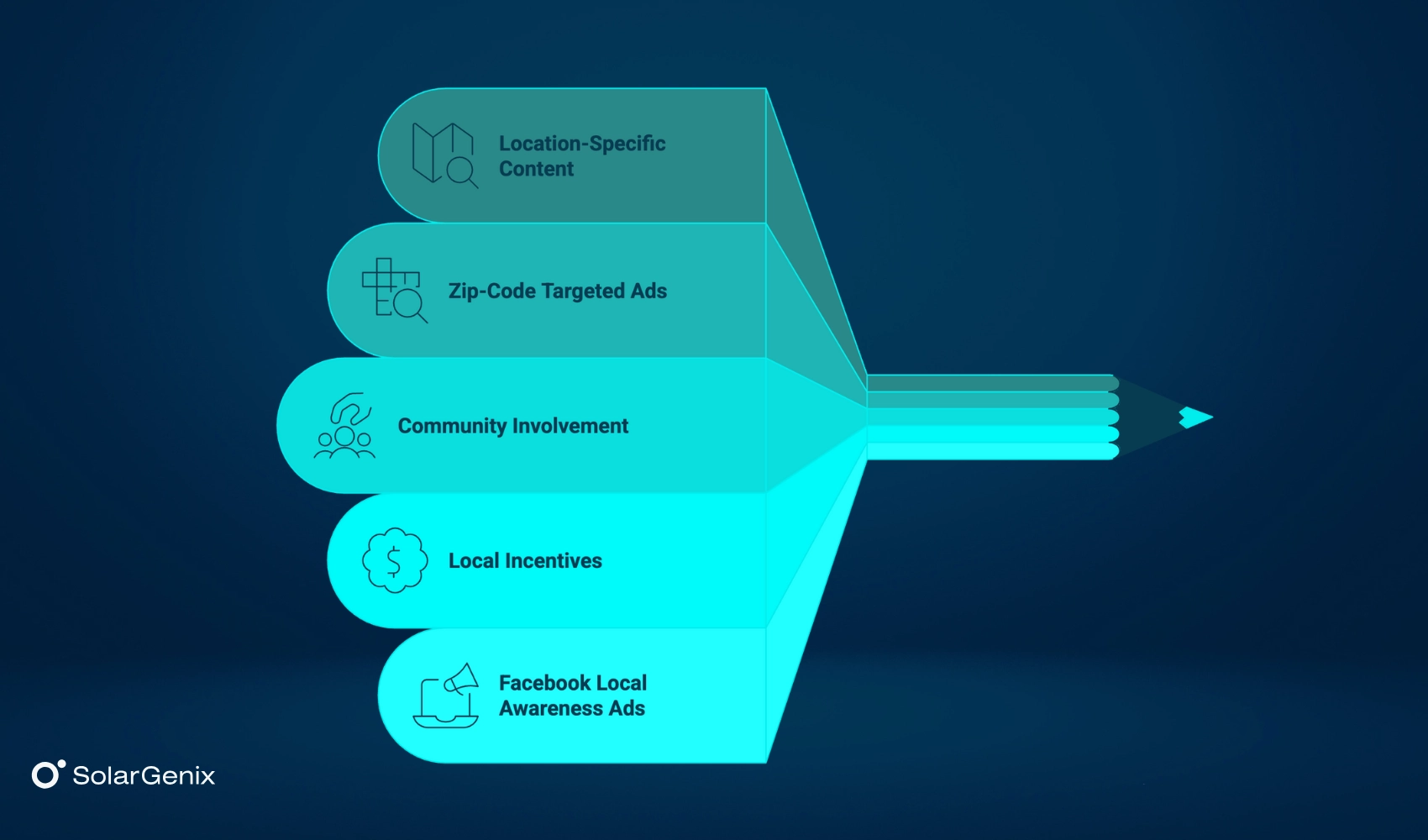
Social media marketing for solar should be optimized for local markets because that’s how solar companies succeed - by dominating the areas they serve instead of trying to compete nationally.
Here’s how you can build local relevance:
- Create location-specific content for each area you serve.
- Run zip-code-targeted ads on Facebook.
- Post about local events, sponsorships, and community involvement.
- Share local incentives and utility updates.
- Use Facebook Local Awareness Ads.
Local SEO and geo-targeting are your non-negotiables for competing and winning locally.
Post Consistently with a Social Media Content Calendar
Consistency helps build trust and brand visibility. It trains your audience to expect regular posts from your company.
On the other hand, posting sporadically damages the algorithm performance, reduces your reach, and is a sign of a lack of commitment to your prospects.
The best way to stay consistent is by creating a monthly content calendar to ensure strategic, planned communication across social media platforms.
How Often to Post on Each Platform?
The recommended posting frequency is:
- Facebook: 3-5 times per week
- Instagram: 4-7 times per week (feed + Stories daily)
- LinkedIn: 2-3 times per week
- YouTube: 1-2 times per week
- TikTok: 3-7 times per week
For best results, try to batch content creation. Create multiple pieces of content in single focused sessions to save time and always have something to post at hand. Schedule batched content in advance.
Balance planned content with real-time posts. Around 70-80% of your calendar should have planned posts created and scheduled in advance. Keep 20-30% free for real-time opportunities - breaking industry news, trends, installation milestones, or other relevant time-sensitive content.
Note: Plan your solar social media campaigns around key dates, such as sunny season months, tax deadlines, or incentive expiries.
Engage with Your Audience Through Comments, Messages, and Stories
Social media is social - it’s not one-way advertising. Homeowners expect you to respond, answer questions, and interact with them.
Here is how to keep the conversation going:
- Reply to comments within 1-2 hours.
- Answer DMs professionally and promptly.
- Use Stories to engage in real time (polls, Q&As, countdowns for promotions, etc.)
- Share and respond to user-generated content.
Show homeowners that they’re talking to real people who care about their concerns.
Partner with Local Influencers and Community Leaders
Followers of local influencers and community leaders trust their recommendations more than traditional advertising. So, when they share about your solar company, it will feel like a genuine recommendation for their audience.
There are several types of local influencers you can partner with:
- Home improvement bloggers/vloggers
- Sustainability advocates
- Local celebrities and business owners
- Community organization leaders
How to Identify and Approach Local Influencers
Search relevant hashtags to find active content creators. Look up engagement rates, content quality, and value alignment. Contact them via DM or email with partnership ideas:
- Sponsored posts showcasing their solar installation
- Collaborative content (Q&As, interviews)
- Referral partnerships
- Event co-hosting
Measure influencer campaign success by monitoring traffic from their posts, tracking discount code usage, asking new leads how they found you, and comparing lead quality coming from influencer traffic with others.
Monitor Social Media Performance and Adjust Your Strategy
Social media marketing for solar companies should be built on data; otherwise, it will turn into a directionless activity.
Track key metrics by goal:
- Awareness: Reach, impressions, follower growth.
- Engagement: Likes, comments, shares, saves - the overall engagement rate.
- Traffic: Link clicks coming from your social accounts.
- Leads: Form submissions, quote requests, and consultation bookings.
- Conversions: Closed deals attributed to social media touchpoints.
Use native analytics tools and third-party platforms like Sprout Social, Buffer, or Hootsuite to understand performance across all social media channels.
Set up conversion tracking through Facebook Pixel and Google Analytics UTM parameters to get accurate data on the connection between your solar social media marketing efforts and website conversions and sales.
Handle Negative Comments and Reviews Professionally
Negative feedback is inevitable if you have a significant online presence. What matters is how you respond to it.
Let’s look at the best practices for handling negative comments and reviews:
- Respond quickly and calmly.
- Stay professional and empathetic.
- Acknowledge the concern.
- Offer to take the conversation offline.
- Provide a solution or next steps.
Never delete comments unless they’re spam, abusive, or violate platform guidelines. Ignore trolls and competitors posing as unhappy customers.
Never get defensive or make excuses.
Use criticism and complaints to improve your services and approaches. Treat them as free consulting about your service gaps.
And lastly, create a crisis communication plan for serious situations that could harm your reputation. Define who responds to different comment types. Practice responses to hypothetical scenarios.
Stay Current with Solar Industry Trends and Social Media Changes
Social media algorithms and technologies are constantly evolving, as are the solar industry trends and possible incentive changes. That’s why it’s crucial to stay on top of all these changes and developments.
- Keep an eye on solar industry news.
- Monitor the social media strategies of your competitors.
- Attend solar and digital marketing conferences.
- Experiment with emerging platforms.
- Keep your content fresh with the latest incentives, technology, and policies.
Sharing current and updated information shows expertise and provides your audience with ongoing value.
Use Solar Proposal Software to Streamline the Social-to-Sale Process
Solar proposal software, like SolarGenix, helps you get back to prospects who have requested quotes or proposals through social media as fast as possible, delivering a professional and branded presentation.
It also lets you shorten the time from interest to quote, preventing the loss of momentum that usually ends many solar deals before they even start. Instead of spending days working on a proposal, you can send it within a matter of hours, maintaining the excitement and interest of your prospects.
Integrate Social Media with Your Overall Solar Marketing Strategy
Homeowners interact with your company across multiple channels, not just social media. They might discover you through social media, then go on to check your website, read reviews, speak with sales reps - there are a ton of touchpoints.
This is why it’s so important to coordinate your solar social media marketing strategies with other channels:
- Email Marketing: You can promote email content and grow your email list using social media channels.
- SEO: Help your SEO by sharing blog articles or new website pages.
- Paid Advertising: Retarget website visitors.
- PR: Share press mentions, awards, and positive media coverage.
Use social media marketing data to improve your other marketing efforts, from blogs to emails and sales presentations.
Common Solar Social Media Marketing Mistakes to Avoid
All businesses make mistakes. You can’t bypass them. The best you can do is understand common pitfalls and try to avoid them in your day-to-day social media marketing processes.
Here are the most common mistakes solar marketers make:
- Being too salesy
- Posting inconsistently
- Ignoring comments and messages
- Using stock photos instead of real installation images
- Posting without a strategy or goals
- Not optimizing content for each platform
- Failing to track performance and ROI
- Ignoring negative feedback or deleting critical comments
- Not investing in paid advertising
- Copying competitors instead of developing a unique voice
- Overlooking video content
- Not educating the audience before selling